Search NC Small Fruit, Specialty Crop, and Tobacco IPM

Showing posts with label invasives. Show all posts

Sunday, February 3, 2013

Spotted wing drosophila confirmed from Indiana and the United Kingdom - Update: SWD also found in Texas and Colorado

States where Drosophila suzukii, also referred to as spotted wing drosophila, has been detected in the continental United States. Adapted from Burrack, et al. 2012. Journal of Integrated Pest Management.


Spotted wing drosophila (SWD) was confirmed in Indiana during October 2012, bringing the total number of states with confirmed populations of SWD to 33.

SWD was also detected in United Kingdom in September 2012, which brings the number of countries (including the US, Canada, and Mexico) where SWD has been detected outside of its presumed native range of eastern Asia to at least nine.

Update, March 7, 2013
While reviewing the National Agricultural Pest Information System's (NAPIS) Pest Tracker records for spotted wing drosophila in preparation for an upcoming presentation, I noticed two additional state level detections for 2012 that I had previous missed, Texas and Colorado.  These detections bring the total number of states where SWD has been detected to 35 since 2008.

More information
First find of spotted wing drosophila in Indiana - Purdue Plant & Pest Diagnostic Laboratory
Strawberry alert: The 2mm fly that could decimate Brittan's fruit industry - The Daily Mail
Drosophila suzukii - European Plant Protection Organization (EPPO) Factsheet

Saturday, February 5, 2011

North Carolina Winegrowers Presentation and Handouts

I will be presenting at the NC Winegrowers Association's annual meeting in Greensboro, NC tomorrow morning. I'll be speaking about grape root borer (a growing concern in NC vineyards), spider mites (a potential pest), grape phylloxera (an emerging issue for hybrid grapes), harvest season insects, and our newest invasive species. I will also be discussing insect monitoring and suggested sampling programs.

Handouts for my talk as well as the slides from my presentation are linked below. As always, information presented about pesticides is intended for North Carolina growers and is subject to change. Always read and follow the pesticide label and see "a note on pesticide recommendations".

More information

Monday, October 11, 2010

Brown Marmorated Stink Bug - Guest post from Anne Nielsen


Anne Nielsen presents on BMSB as part of the Entomology Department seminar series at University of California, Davis. Photo: UCD

Anne Nielsen was among the first entomologists to study the brown marmorated stink bug after its introduction to North America.  I contacted her last week to get her insights on the pest potential of BMSB in North Carolina.  Dr. Nielsen is currently a post doctoral researcher at Michigan State University.  Below are her comments.

BMSB is predicted to have at least 2 generations per year in your region.  Given what populations have done in the Mid-Atlantic, it is highly likely that BMSB will become a pest in North Carolina as well.  In other states, significant feeding damage has occurred in pome or stone fruit. It will readily feed on vegetables (soybean, tomatoes, peppers and corn) and small fruit, although damage reports haven't been as severe in these crops to date.  I would expect it to feed on cotton, as other pentatomids do, but we don't have any data to confirm that yet.  Populations will be highest in late summer/early fall as the final adult generation prepares for diapause.  This adult generation is also highly attracted to blacklight traps, which are a very good way of identifying populations at low densities in the
farmscape.  Within two years of detection on farms in Pennsylvania and New Jersey, BMSB has negatively impacted the exant pentatomid community in terms of species richness and species evenness.  This is not surprising given the low rates of egg parasitism we have seen.  BMSB appears to be highly aggregated in the crops where it is present, although distributions can be patchy.

We noticed that new locations were usually first identified as a result of their overwintering behavior. George Hamilton and I set-up a website (which he still manages) that allows homeowners to learn about BMSB as well as report sightings.  We were able to learn of numerous new state records in this way and feel free to pass along the web site to your county offices and end-users.  I think it is important to have a centralized database for this type of information.

In other areas, there was a 3-5 year lag between the time of detection in a state and high numbers in agricultural crops.  However, I would not be surprised in BMSB has been in North Carolina for a few years already.

More information

Sunday, October 10, 2010

A fall visitor: Brown marmorated stink bug

Stink bug adult on the hood of my car. Photo: HJB
After running errands Saturday morning, I noticed the insect above on the hood of my car. My apologies for the poor photo quality, but it was the best I could manage on the fly with my cell phone camera. This morning, another greeted me inside my living room window, leaving behind the trans-2-decenal and trans-2-octenal to prove it. From the glimpse I got, it appeared to be a brown marmorated stink bug (BMSB, Halyomorpha halys). This invasive insect has temporarily taken the place of bed bugs as the go to pest, garnering attention from the New York Times, Washington Post, and even NPR's Science Friday. A multi agency work group has been established to study BMSB biology, management, and regulation.


Why has BMSB generated so much interest this fall? For two main reasons:
1. Large populations have caused extensive damage in agricultural crops, and
2. They aggregate in structures in large numbers in the fall, becoming a nuisance pest.


First detected near Allentown, PA in 1998, BMSB has been present in the United States since then, but this summer their populations increased dramatically in the mid Atlantic. BMSB has been present in North Carolina since at least 2009, but has not reached the damaging levels observed in Maryland, north east Virginia, and Pennsylvania this year.


BMSB damage on an apple. The corky masses below the skin are distinctive of stink bug feeding. Photo: Penn State Extension
From mid summer through fall, BMSB has caused significant damage in the mid Atlantic to apples, peaches, caneberries, corn, and soybeans, to name a few of the crops it has been recorded from. Stink bugs, including our native species, the brown stink bug (Euschistus servus), green stink bug (Acrosternum hilare), and southern green stink bug (Nezara viridula), are difficult to manage with insecticides. Typically, broad spectrum materials, such as pyrethriods, carbamates, and organophosphates have been used to manage stink bugs, but may of these have the potential to create unintended consequences, like reducing natural enemies. Treatments for BMSB did not fit with carefully developed IPM programs for tree fruit in Maryland and Virginia, and resulted in greater pesticide use.


Stink bugs (native and non native) are emerging pests in many cropping systems due in part to their difficulty to control and in part to the increased number of insecticides (or other tools) that target a narrow range of organisms. For example, stink bugs are now a key pest of cotton due to the widespread adoption of Bt varieties that control caterpillars. Foliar applications of broad spectrum insecticides targeting caterpillars used to also control stink bugs but are no longer needed. The same scenario could apply to systems that have switched to other newer insecticides (i.e. Entrust, Delegate, Intrepid, Coragen, and many others) from broad spectrum materials.


The second reason BMSB has generated such wide attention is its tendency to aggregate in structures in the fall, much like the multicolored Asian lady beetle and another recently introduced bug, the "kudzu bug". All of these insects are native to roughly the same part of the world, China, Japan, and Korea, so it is possible that this fall aggregation behavior is associated with insects from these areas.


What should growers do if they suspect BMSB is present on their farm? Contact your cooperative extension agent to confirm identification and for management recomendations.


What should homeowners do if they suspect BMSB are present in their yards or homes? If BMSB are presents in your yard, there are few control measures that will be effective, and the most sustainable strategy is to tolerate injury to plants. If stink bugs are entering your home, seal entry points well (think of it as an entomological energy audit) and vacuum up the insects, disposing of your vacuum bag.

More information

Friday, October 8, 2010

A different story at the Sandhills

After yesterday's visit to the Upper Mountain Research Station, I was eager to check my spotted wing drosophila (SWD) traps at the Sandhills Research Station today.  My first stop at the station was the caneberry breeding plots.

Caneberry seedling plots at Sandhills Research Station.  Photo: HJB
Raspberries are grown at Sandhills not because they do well here but because most raspberries cannot tolerate high heat.  The plots here are intended to screen breeding material for heat tolerance traits that will be used to develop raspberries that can be grown in hot summers.  In other words, most raspberries are not happy at the Sandhills.

We began catching SWD adults at the Sandhills on 11 August 2010 and trap captures peaked on 18 August.  See trapping data here.  Dates are in ordinal days; see here to convert ordinal days into calendar dates.  There were no blackberries present at this time, few peaches were remaining, and no larvae were found in fruit.  No flies were captured during the month of September, and one fly was caught last week.

SWD and raspberries have a lot in common in terms of temperature tolerance.  Both like mild weather and, at least according to current literature for SWD, do not reproduce in hot weather.  I suspect that the record heat this summer may have limited SWD's initial spread through North Carolina, but now as fall temperatures cool, we may see more flies and more maggots.

There were a few raspberry plants with fruit, and most of what I observed did not contain visible larvae.  I did find one, otherwise perfectly sound fruit, that contained one early instar larva.

Early instar maggot (center of image), likely spotted wing drosophila, in a red ripe raspberry at the Sandhills Research Station, Jackson Springs, NC. Photo: HJB
Because this larva was so small, I collected a sample of other raspberries from the field and will be holding these to determine if any others contain SWD larvae.

Ripe and overripe raspberries collected to determine the presence of SWD larvae at the Sandhills Research Station. Photo: HJB
 So, why do we have a large amount of infested fruit at Upper Mountain and very little (apparently) infested fruit at Sandhills?  Fruit availability differs between these two site this time of year; Upper Mountain has strawberries, caneberries, and grapes ripe and open to infestation while Sandhills only has a few remaining raspberries.  But why did the Sandhills infestation not take off when the hundreds of peach trees at the station were loaded with fruit?  The flies were not present in high numbers at the height of peach season, but I also think climate played an important role.  The Sandhills are in the hottest part of North Carolina, and peach season is during the hottest part of the year.  This may have limited the spread of SWD into the Sandhills this summer.  Now that the fly is present and reproducing, it will be interesting to see what next summer holds.  We will be there to find out.


Sponsored by the Southern Region Small Fruit Consortium, Project 2010 E-01.

SWD appears with a vengeance at Upper Mountain Research Station

Male D. suzukii on raspberry leaf, Upper Mountain Research Station.  Photo taken 30 September 2010 by Absalom Shank, NC State Horticulture Department

Yesterday, I spent the day at the Upper Mountain Research Station near Laurel Springs confirming the first spotted wing drosophila (Drosophila suzukii) larval infestation in North Carolina.  Spotted wing drosophila (SWD) is a potentially devastating invasive pest of soft skinned fruit which has been present in North American since late 2008.  See here for more background.  Blackberry, raspberry, and strawberry research plots are heavily infested.  SWD were first observed on 30 September in high tunnel primocane fruiting raspberry plots by Absalom Shank, research technician in the NC State Horticulture Department.

Up until last week, no larval SWD had been observed in North or South Carolina, despite the fact that adults have been captured in high numbers.  This is likely due to the fact that most of our trap captures occurred after the majority of susceptible host fruit had been harvested.  It is likely that larvae have been present but in low enough numbers that they escaped detection.

The first thing I did after arriving at the station was to place 6 SWD traps in 3 of 4 high tunnels, where the highest number of flies had been observed.  These tunnels contain primocane and floricane fruiting blackberries and raspberries. Three of the traps were baited with apple cider vinegar, and 3 were baited with a yeast and sugar mixture, as are being used in our regional monitoring program.  Within 20 minutes, the first adults appeared at the apple cider vinegar baited traps.  A total of 4 flies were captured in 3 hours.

Apple cider vinegar baited SWD trap in primocane fruiting blackberry tunnel.  Photo: HJB


Male SWD at apple cider vinegar baited trap entry.  Photo: HJB

SWD larvae were observed last week in fruit from guard plants and caneberry seedling plots, both of which are not regularly harvested.  This week, larvae were found in trial plots, which are harvested twice per week, so flies are not restricted to unharvested plantings.

Fallen raspberries in breeding plots.  These fruit can harbor SWD populations. Photo: HJB
Adult SWD were readily observed and collected in high tunnel plots (and the most of those were in primocane fruiting raspberries), but were not as numerous in outside plots.

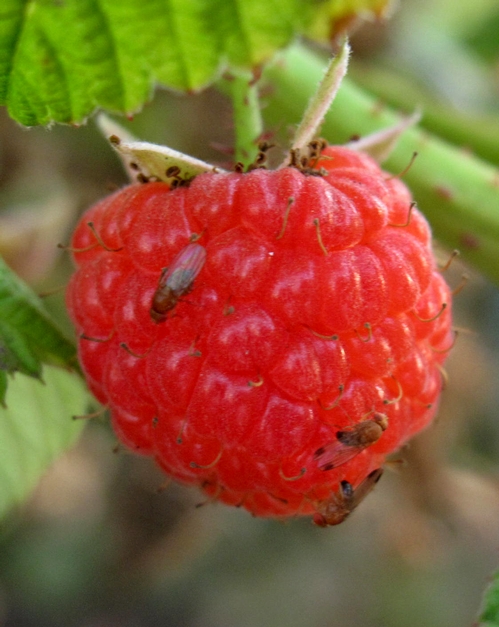
Female SWD on ripe raspberry fruit in a high tunnel.  Photo: HJB
Primocane fruiting blackberries in high tunnel.  Photo: HJB.
Primocane fruiting raspberries outside. Photo:; HJB
Many fruit in raspberry breeding/seedling plots were heavily infested, which is not surprising considering that these plots have never been harvested.  Most of the fruit collected contained multiple larvae.

Ripe yellow raspberry from breeding plot.   This single fruit contained 5 SWD larvae.  Photo: HJB
Strawberry plots at the station also contained large numbers of SWD larvae.  Because it was very windy, adult fly presence could not be confirmed in these plots.  Flies which appeared to be SWD females were present, but these are more difficult to sight identify than males.  The fruit damage observed, however, was consistent with SWD.  Sound appearing fruit contained multiple maggots when cut open.  Larvae were collected to rear out adults.

Strawberry containing multiple SWD larvae.  Photo: HJB
These strawberry plots had also not been harvested for several months and contained sound, rotting, and decomposed fruit, all of which are attractive and suitable for SWD larval feeding.

Strawberry plots containing heavily SWD infested fruit.  Photo: HJB
Strawberries with recently laid SWD eggs were also found.  These fruit appeared sound except for a slightly abraded area where the eggs were.

Strawberry fruit with slightly abraded area containing SWD eggs.  Photo: HJB
Enlarged view of SWD eggs.  Photo: HJB
I collected several adult flies and numerous infested fruit to bring back to laboratory to start a research colony.  These insects will be used to test host fruit preference, monitoring tools, and control strategies.  This afternoon I am heading to check my traps at the Sandhills Research Station and check the caneberry breeding plots there for larval infestation. Update: I visited the Sandhills Station today.  See here for a summary of what I found.


SWD Monitoring
We have been monitoring SWD in NC, SC, and VA for 5 months and have detected flies in Montgomery County, NC; Lee County, NC; Randolph County, NC; Davidson County, NC; Edgecombe County, NC; Saluda County SC; Spartanburg County, SC; and Lexington County, NC.  We can now add Ashe County, NC to that list.

Small fruit and tree fruit growers should be aware that SWD populations are present at potentially damaging levels and should carefully monitor their plantings for adult and larval presence.  Caneberry growers with primocane fruiting berries and strawberry growers with fall fruiting or day neutral plantings should be especially aware.  Adult traps can be constructed from plastic containers or bottles (see here for a description of trap construction and here for videos demonstrating trap construction and use).  Sticky cards for use in traps can be obtained from a variety of sources.  We get ours from Great Lakes IPM.  Male SWD are readily distinguished from other flies by their spotted wings.  Females are more difficult to distinguish, and growers should consult their county extension agent for identification confirmation if males are not present.  See here for examples of SWD and non SWD flies on sticky traps.  Traps should be checked at least weekly.

Growers should also monitor fruit for larval infestation.  Large larvae will be visible in fruit, but small larvae may not.  Larvae can most easily be detected via the "fruit dunk" method.  Fruit are gently crushed and floated in sugar water.  After several minutes, larvae float to the surface and can be counted.   See here for a video and here for a description.  A hand lens may be necessary to observe small larvae.  It is important to remember that many native Drosophila feed on rotting fruit.  Observing infestation in relatively sound fruit and confirming adult presence minimizes the likelihood that you will confuse SWD with native relatives.

SWD Management
Sanitation is extremely important in managing SWD.  In areas where SWD is present, all ripe fruit should be removed from the field or plants should be treated with insecticide regularly, with the interval depending upon the material used.  Unmarketable fruit should be destroyed or removed from the site.  Composting may not be sufficient to kill SWD larvae and may attract adults to rotting fruit.  This presents a challenge to fruit breeding activities at research stations and will need to managed with care.

SWD populations in the western US (California, Oregon, and Washington) appear to respond well to a number of insecticides, which is encouraging news.  I am preparing a document listing the registered materials that are effective against SWD by crop and will have this available early next week.  Growers who have confirmed SWD should contact their county cooperative extension agent or myself for management recommendations.  It is especially important to rotate insecticides used to treat SWD to minimize the likelihood of resistance development.

More information
OSU SWD Website
Spotted Wing Drosophila Updates - WSU Mount Vernon Research Center
Strawberries and Caneberries - Blog by Mark Bolda (UC Farm Advisor)
NC Small Fruits IPM SWD Posts


Sponsored by the Southern Region Small Fruit Consortium, Project 2010 E-01.

Friday, April 2, 2010

Economic impact of SWD

Mark Bolda, UC Farm Adviser for Santa Cruz, Monterey and San Benito Counties, has posted a link to a recent report authored by himself, Rachel Goodhue (UC Davis Agriculture and Resource Economics), and Frank Zalom (UC Davis Entomology) which details the potential economic impact of spotted wing drosophila (SWD) in California, Oregon, and Washington. It's worth a read in its entirety, but part of the take home message is that annual losses (based on 2008 revues) for SWD in these 3 states could top $420 million. It's also worth noting that these states have significant acreages of SWD host crops (76% of total US production by the author's estimates), so these potential losses cannot necessarily be generalized across the country. This this, however, a stark reminder that SWD has the potential to become a significant pest in small fruit production and that we need to be on top of it from detection to establishment.

Remember, SWD monitoring will begin this month. It's not too late to be involved. Contact Hannah Burrack for more details.

Further resources:
Spotted Wing Drosophila: Potential Economic Impact of a Newly Established Pest

Wednesday, February 17, 2010

Brown marmorated stink bug

This morning I'm kicking myself for not taking a closer look at the stink bug I scooped off my floor last night! Chances are, it was a brown marmorated stink bug, an invasive insect native to Asia (China & Japan). Brown marmorated stink bugs (Halyomorpha halys) are potential crop pests of fruits (grapes, caneberries, and peaches are the most likely hosts here), but have not been numerous in NC in recent years. Their feeding behavior and potential damage are the same as many native stink bugs, such as the brown, green, and southern green stink bugs, so changes in management practices will likely not be needed.

Where the brown marmorated stink bug has become a more serious concern is in the home. Much like their fellow Asian import, the multicolored Asian lady beetle, the brown marmorated stink bug aggregates in structures during the fall and winter and can be a nuisance pest. NCSU entomologists Stephen Bambara, Mike Waldvogel & Steven Frank have compiled information about the brown marmorated stink bug in NC, which can be found here.

A group at Rutgers has put together a really entertaining video highlighting this concern--it's worth a look:

Monday, February 1, 2010

Spotted Wing Drosophila monitoring to begin in April!


Female SWD. Image via www.ipm.ucdavis.edu.

The Southern Region Small Fruit Consortium has recently funded monitoring efforts for the spotted wing drosophila (D. suzukii) in the southeast. Our work will rely upon a volunteer network of agricultural professionals, including county cooperative extension agents, master gardeners, and certified crop consultants. Monitoring efforts will be on a volunteer basis, but training, support, and materials will be provided. Training sessions will begin in March 2010, and monitoring efforts are targeted to begin in April. Monitoring locations will include backyard gardens and non commerical plantings of potential host plants (ie. peaches, strawberries, grapes, blueberries, and caneberries). We will avoid be monitoring commercial small fruit farms in the first stage of this project, because of potential regulatory implications. If and when SWD are detected and confirmed in a region, we may include commerical grower sites if there is sufficient interest.

This project will initially focus on North Carolina, Virginia, and South Carolina, but training and methods will be available to interested parties from other states upon request. If you are interested in participating in monitoring efforts, contact Hannah Burrack.

Monitoring information will be collected via Google Documents and shared via this website and others.

UPDATE:
We will now include commercial farms as possible monitoring sites.

Saturday, November 7, 2009

SWD Climate model and OSU work group


The map above is from a report complied by Martin Damus of the Canadian Food Inspection Agency and hosted on the website for the Oregon spotted wing drosophila workgroup. It illustrates the areas with temperature suitable for spotted wing drosophila survival. The methods used to develop this map are summarized in the report and rely heavily on data from the fly's native range, but it is a striking illustration that the eastern US is potentially at greater risk that the west. This greater potential risk has not necessarily translated to greater emphasis on this on preventing and/or detecting this pest. I was impressed with the steps taken by the Oregon group and will be following their activities over the winter.

Tuesday, October 6, 2009

Check out the newest Small Fruit News

The latest edition of the Small Fruit News has just been posted at the Southern Region Small Fruit Consortium's webpage. I contributed an article on the spotted wing drosophila to this quarter's edition which expands on my previous post here. The most interesting article to me was contributed by Phil Brannen, University of Georgia plant pathologist, which briefly discusses 2 viruses new to eastern blueberry production.

Blueberry scorch and blueberry shock have been detected in locations in Michigan, the nation's largest blueberry producer. Among these locations is the Trevor Nichols Research Complex, where much of the blueberry research in the state is conducted. Blueberry scorch is vectored by aphids (likely non persistently), although the potential vectors are unclear. Blueberry shock is a pollen borne virus whose spread is mediated by bees. These viruses have yet to be detected in the southeast, but their movement across the US from the Pacific northwest to Michigan raises concern.

More information on Blueberry scorch and shock is Michigan can be found here.

Tuesday, September 22, 2009

An emerging pest, on the march!

Spotted wing drosophila on raspberry in Northern California. Males have spots on the ends each of their wings, while females do not. Image from the UC ANR Strawberry and Caneberry Blog, courtesy Ed Show.

Formerly known as the cherry vinegar fly, the
spotted wing drosophila (Drosophila suzukii) has rapidly progressed from recently detected invader to significant pest of fruit in California. The fly was first detected in fall 2008 and was confirmed in backyard and commercial cherry plantings in spring 2009. Experts in California believe it has been present for at least a year prior to that detection. On August 4, 2009, the spotted wing drosophila was detected in Hillsborough County in central Florida.

What makes the spotted wing drosophila a concern to growers and entomologists alike is the fact that its serrated ovipositor (egg laying devise) allows it to attack sound fruit. Of the nearly 1500 known drosophila species, only 2 are pests of sound fruit, one of which is the spotted wing drosophila. Most other drosophila flies feed on the microorganisms that inhabit rotting fruit or plant tissue, and therefore are not typically crop pests.

Any soft fruit is likely at risk for damage by this pest, which includes caneberries, strawberries, peaches, grapes, blueberries, and figs. Research in California indicates that the fly completes a generation in approximately 2 weeks. Infested fruit appears bruised from the outside, and small (1-2 mm) larvae feed internally.

Because they are present in Florida, it's only a matter of time before the spotted wing drosophila makes it way to North Carolina. I will be working with county agents this winter to establish a monitoring network in high risk counties. Please contact your county agent or myself if you suspect spotted wing drosophila damage in your fruit.

You can find more information on spotted wing drosophila at the following links:

Followers