At last Friday's vineyard tour, one of the most common insect questions I get from grape growers again came up. "What can I do about wasps and (less commonly) bees in my grapes?"
My feelings are clear on this subject. I think there is little to be gained from using insecticides against these mostly beneficial insects and significant harm that could be done, both through extending your harvest window and by harming predators and pollinators. You can read my thoughts on this subject and what growers can do instead of spraying, here.
Today, I read about an even better reason to appreciate wasps, in particular, in your vineyard. NPR's The Salt blog highlights research from Italy that demonstrates that wasps move wine-fermenting yeasts throughout vineyards and have likely contributed to the evolution of these important yeasts. You can find the full article here.
More information
What to watch for - Bees and wasps in grapes
Thank the simple wasp for that complex glass of wine - The Salt
Role of social wasps in Sacromyces cerevisiae ecology and evolution - Proceedings of the National Academy of Sciences
Showing posts with label grapes. Show all posts
Showing posts with label grapes. Show all posts
Tuesday, July 31, 2012


Wednesday, July 11, 2012
NC State summer vineyard tour - 27 July
NC State University grape experts will be leading a tour of muscadine and vinfera vinyards on 27 July. We'll be hosted by Cauble Creek Vineyard and Morgan Ridge Vineyard, both in Rowan County.
I will be discussing the Grape Root Borer Volunteer Monitoring Network (GRB*VMN) and kicking off 2012 monitoring!
Preregistration is required by 24 July. See the program below for the registration form and details on the other presenters.
I will be discussing the Grape Root Borer Volunteer Monitoring Network (GRB*VMN) and kicking off 2012 monitoring!
Preregistration is required by 24 July. See the program below for the registration form and details on the other presenters.
Monday, August 8, 2011
Grape Root Borer*Volunteer Monitoring Network trapping data now available
The Grape Root Borer*Volunteer Monitoring Network (GRB*VMN) has been up and running for a month, but the first, substantial trap captures occurred last week. The network consists of 10 locations in 7 North Carolina counties. Trap captures from these sites will be available here through the end of October, when the grape root borer flight is expected to end.

Rowan County 1

Rowan County 2

Davie County 1

Yadkin County 1

Surry County 1

Surry County 2

Surry County 3

Wilkes County 1

Haywood County 1

The highest number of trap captures is currently in Davie County with a few other locations catching a few moths. It is interesting that our flight appears to be occurring so late in the year, since reports of moth captures begin in July last year. We are monitoring the grape root borer flight in North Carolina to better understand when and where our highest populations occur. This information is important when making grape root borer management decisions, in particular whether or not to use currently labeled pesticides, which must be used either 30 days before harvest or after harvest. If you are interested in monitoring grape root borer yourself, see here for more information.
More information Do it yourself - Grape root borer monitoring
 |
| 2011 GRB*VMN sites. Sites are only identified to the county level and assigned a number for record keeping purposes when there are multiple sites per county. |
Monitoring locations and trapping data are listed below, from east to west:
Jones County 1

Rowan County 1

Rowan County 2

Davie County 1

Yadkin County 1

Surry County 1

Surry County 2

Surry County 3

Wilkes County 1

Haywood County 1

The highest number of trap captures is currently in Davie County with a few other locations catching a few moths. It is interesting that our flight appears to be occurring so late in the year, since reports of moth captures begin in July last year. We are monitoring the grape root borer flight in North Carolina to better understand when and where our highest populations occur. This information is important when making grape root borer management decisions, in particular whether or not to use currently labeled pesticides, which must be used either 30 days before harvest or after harvest. If you are interested in monitoring grape root borer yourself, see here for more information.
More information Do it yourself - Grape root borer monitoring
Saturday, June 25, 2011
Do it yourself - Grape root borer monitoring
Tomorrow, June 26, I will be kicking off the 2011 Grape Root Borer Volunteer Monitoring Network (GRB*VMN) at the NC Winegrowers Association summer picnic. I will be distributing trapping kits to volunteer growers and demonstrating trapping methods. For grape growers interested in monitoring for grape root borer who cannot attend the meeting, this post details how to monitor on your own. If you are interested in participating in the GRP*VMN, please contact me for more information.
The traps I use are available from Great Lakes IPM* and pheromone lures can be purchased from Arbico-Organics*.
Grape root borer (Vitacea polistiformis (Harris)) is potentially the most significant pest of grapes (both muscadine and Vinfera) in the southeast. Larvae have a 1 to 2 year life cycle, which means that injury, in the form of weakened and dying vines, often does not present for several years. Many of the Vinfera vineyards in the Carolinas and Georgia are reaching the 8 to 10 year mark, the time at which I anticipate grape root borer injury to become more apparent.
The GRB*VMN has two purposes:
1. To determine the density, range, and seasonal biology of grape root borer in North Carolina. In other words, to find out how many moths we have in our vineyards, which vineyards they are present in, and at what time of year they are active.
2. To give NC grape growers the skills to monitor for grape root borer and make management decisions based on monitoring information.
To accomplish these goals, we will train grape growers throughout the state to monitor for grape root borer adults on their farms and share their data through this blog.
Monitoring methods
We will place 4 universal moth traps per vineyard. Ideally, we will place these traps each in a different variety (if present). Within variety blocks, traps should be placed in low lying, wet areas, since these are at the highest risk of grape root borer infestation.
 |
| Grape root borer trap components. From left to right: hanger, trap top, trap lid, pheromone container (front), pheromone impregnated septa (packet, front), pesticide kill strip (red, front), and trap bottom (back). |
 |
| Pesticide strips placed in trap bottom. |
 |
| Trap top attached to bottom. |
Trap tops snap onto to trap bottoms.
 |
| Trap lid added to trap top. |
Trap lids keep rain and other debris out of the bottoms.
 |
| Grape root borer pheromone impregnated septa. |
Grape root borer pheromones are impregnated onto rubber septa and remain attractive for an entire field season.
 |
| Pheromone lure placed in pheromone container. |
Pheromone lures are placed into lidded containers.
 |
| Assembled trap. |
The pheromone container is inserted in the trap lid and hangs into the trap opening. Moths are attracted to pheromone lures and fall into the trap bottom where they are killed by the pesticide strip. Hangers are attached to trap lids, and traps are hung from canes or trellis wires.
 |
| Assembled grape root borer trap |
Traps are checked weekly and moths are counted. Pheromone lures are attractive at a long distance to male moths, and attractive at a short distance to females, so both sexes may be present in traps. Grape root borer moths resemble wasps but differ in that their wings are black and they lack the thin "waist" of wasps. After a few days in the traps, moths may appear darker brown (see below).
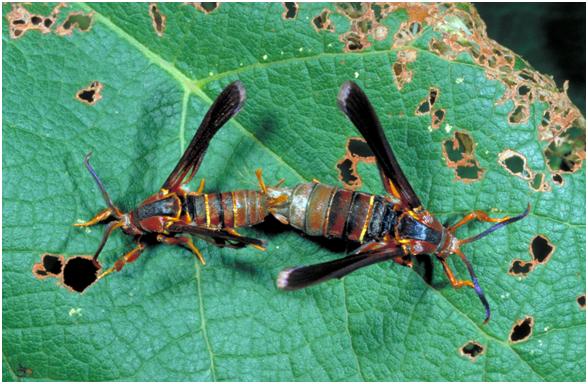 |
| Mating male (left) and female (right) grape root borer moths. Photo: University of Kentucky. |
 |
| Female grape root borer moth one week after collection. |
 |
| Mating male (left) and female (right) squash vine borer moths. Photo: University of Minnesota |
Data collected by the GRB*VMN will be entered online weekly and will be shared here, beginning the first week of July.
*Does not imply endorsement of named vendors over other options.
NC Winegrowers Association - Summer Picnic
Tuesday, April 5, 2011
What to Watch for - The cicadas are coming! What does this mean for berry crops?
I received an email yesterday from a relatively new blueberry grower in Tennessee which asked an intriguing question: "...Tennessee is expecting the 13-year cicadas in a couple of months. We planted our first planting of blueberries in the spring of last year (2010) so they are coming into their second year of growth. Will the cicadas damage them and if so is there anything preventative we can do?"
For those of you who haven't heard the news, this summer, much of the eastern United States will experience the emergence of Brood XIX (also known as "The Great Southern Brood"), the 19th Brood for this population of 13-year periodic cicadas. Cicada adults are large, stout insects that feed on plant xylem. Immature cicadas (nymphs) live underground and feed on roots. Periodic cicadas, members of the evocatively named genus Magicicada, synchronize their life cycle so that the adults all emerge together over a short period of time. This adaptation is presumed to be a defense against predation by overwhelming possibly predators. In addition to the 13-year cicadas that will be emerging in 2011, there are also 17-year periodic cicadas and many non-periodic cicadas that do not synchronize their emergence. There are also non-periodic species of cicadas, often called "dog day" cicadas because the adults emerge during the hottest part of the summer.
 |
| Adult periodic cicada. Photo: Bruce Marlin, Wikipedia. |

 |
| Adult cicada emerging from nymphal exoskeleton. Photo: Joseph O'Brien, BugWood. |
The first part of the question above is relatively easy to answer. Yes, cicadas may potentially damage blueberries and other woody perennials such as grapes and caneberries. Young plants, like the recently planted blueberries at our Tennessee grower's farm are likely at greater risk than established plantings. Strawberries are not at risk of cicada injury because they only lay eggs in woody perennials. Of course, in order for periodic cicadas to damage plants, they need to be present in large numbers. While Brood XIX is expected to emerge over a wide area of the southeastern United States, mass emergence will not occur everywhere. See here for a map of where Brood XIX is expected to emerge, and check here to see if they have been recorded from your town. Chances are good that you will experience Brood XIX this summer if periodic cicadas emerged in your area 13 years ago, and you are in the zone where they are expected. Cicada Mania is an excellent online compendium of all things cicada-related. Adult cicada emergence begins when soil temperatures reach 64F. For those of you without soil probes, Cicada Mania has posted an emergence calculator based on air temperature.
Damage to plants from adult cicada feeding is typically minimal, even for large, periodic emergences. Of greater concern is the damage that females cause through egg laying. Adult cicadas lay their eggs in woody tissue, under the bark. From the outside, these oviposition scars look like ragged cuts.
The leaves beyond oviposition scars wilt and are referred to as "flags".
Damage to plants from adult cicada feeding is typically minimal, even for large, periodic emergences. Of greater concern is the damage that females cause through egg laying. Adult cicadas lay their eggs in woody tissue, under the bark. From the outside, these oviposition scars look like ragged cuts.
The leaves beyond oviposition scars wilt and are referred to as "flags".
 |
| Periodic cicada eggs inside a twig. Photo: John Ghent, BugWood. |
The second part of the question is a bit trickier. Preventative treatments may be tempting, and soil treatments of insecticides have show promise in reducing the number of egg laying attempts by female cicadas. However, preventative treatments must be made before insects are present. This means that they may not end up being beneficial if large numbers of cicadas do not appear. Some foliar insecticides may also repel adult cicadas. For small plantings, netting is very effective at reducing or eliminating egg laying. In locations with young plantings a high likelihood of emergence, preventative treatment may be a good choice. For specific recommendations, contact your county cooperative extension agent. If you are in North Carolina, see here to find your county extension office. If you are in another state, you can find your location extension resources here (select your location at the top of the page).
Saturday, February 5, 2011
North Carolina Winegrowers Presentation and Handouts
I will be presenting at the NC Winegrowers Association's annual meeting in Greensboro, NC tomorrow morning. I'll be speaking about grape root borer (a growing concern in NC vineyards), spider mites (a potential pest), grape phylloxera (an emerging issue for hybrid grapes), harvest season insects, and our newest invasive species. I will also be discussing insect monitoring and suggested sampling programs.
Handouts for my talk as well as the slides from my presentation are linked below. As always, information presented about pesticides is intended for North Carolina growers and is subject to change. Always read and follow the pesticide label and see "a note on pesticide recommendations".
More information
Tuesday, January 11, 2011
Management tools for spotted wing drosophila in NC
Because we detected spotted wing drosophila (SWD) in the Carolinas in 2010 before any commercial fruit was compromised, we have this winter to prepare growers and homeowners to detect and manage this new pest.
The first step to managing SWD is to determine whether it is present on your farm or garden. We have detected SWD in 13 counties in NC and SC, but we have been monitoring 24 locations and do not have traps in all possible fruit growing areas. This means that: 1. Some locations do not yet have SWD, and 2. Some locations may have SWD and we may not have detected it yet.

2010 NC and SC SWD Monitoring locations (blue dots) and counties with confirmed SWD trap captures. Figure: HJB
Growers and gardeners should work with their county extension agents (or myself) to trap for and identify SWD. See here to find your county extension agent in NC. Expert identification confirmation is recommended for the first detection at location to ensure that SWD is not confused with native Drosophila species. See the NC Small Fruits, Special Crop, and Tobacco IPM SWD Page for links to SWD identification guides.
Once SWD presence has been confirmed and at risk (ripe) fruit is present, chemical treatment is the current recommended means of commerical management. Cultural control, namely sanitation, can greatly reduce damage but will not eliminate it. Fruit should be frequently and regularly harvested and culls (non marketable or non edible fruit) should be disposed of off site. Burying culls will not necessarily kill SWD. Culls should not be left on the ground because they can be reinfested.
I have adapted factsheets which list the registered, commerical insecticides and their possible impact on SWD developed by Oregon State University entomologists for North Carolina. Links to these factsheets are provided below. The insecticides listed are registered for commerical fruit production, not for use by homeowners. Cultural controls may be sufficient to reduce SWD damage in gardens. If not, contact your cooperative extension agent for pesticide recommendations. The information provided in these factsheets does not replace the insecticide label. The label must be followed at all times; it's the law!
More information
Insecticides registered for use in blueberries & their potential use against SWD
Insecticides registered for use in caneberries & their potential use against SWD
Insecticides registered for use in grapes & their potential use against SWD
Insecticides registered for use in strawberries & their potential use against SWD
The first step to managing SWD is to determine whether it is present on your farm or garden. We have detected SWD in 13 counties in NC and SC, but we have been monitoring 24 locations and do not have traps in all possible fruit growing areas. This means that: 1. Some locations do not yet have SWD, and 2. Some locations may have SWD and we may not have detected it yet.

2010 NC and SC SWD Monitoring locations (blue dots) and counties with confirmed SWD trap captures. Figure: HJB
Growers and gardeners should work with their county extension agents (or myself) to trap for and identify SWD. See here to find your county extension agent in NC. Expert identification confirmation is recommended for the first detection at location to ensure that SWD is not confused with native Drosophila species. See the NC Small Fruits, Special Crop, and Tobacco IPM SWD Page for links to SWD identification guides.
Once SWD presence has been confirmed and at risk (ripe) fruit is present, chemical treatment is the current recommended means of commerical management. Cultural control, namely sanitation, can greatly reduce damage but will not eliminate it. Fruit should be frequently and regularly harvested and culls (non marketable or non edible fruit) should be disposed of off site. Burying culls will not necessarily kill SWD. Culls should not be left on the ground because they can be reinfested.
I have adapted factsheets which list the registered, commerical insecticides and their possible impact on SWD developed by Oregon State University entomologists for North Carolina. Links to these factsheets are provided below. The insecticides listed are registered for commerical fruit production, not for use by homeowners. Cultural controls may be sufficient to reduce SWD damage in gardens. If not, contact your cooperative extension agent for pesticide recommendations. The information provided in these factsheets does not replace the insecticide label. The label must be followed at all times; it's the law!
More information
Insecticides registered for use in blueberries & their potential use against SWD
Insecticides registered for use in caneberries & their potential use against SWD
Insecticides registered for use in grapes & their potential use against SWD
Insecticides registered for use in strawberries & their potential use against SWD
Thursday, January 6, 2011
Upcoming Grower Meetings
It's taken me a while to put together a list of winter meetings, and it's already meeting season! Below is a summary of the meetings I will be attending and the topics I will be covering. Hope to see you there! I've listed the number of attendees behind those meetings that have already occurred.
Tobacco meetings
January 11, 12pm. Coastal Plain tobacco production meeting. Rocky Mount Farmers Market, Rocky Mount, NC. Topic: New pesticides and their use, Late season insect management. 130 attendees.
January 13, 12pm. Lenoir County tobacco production meeting. Lenoir County Center, Kinston, NC. Topic: New pesticides and their use, Late season insect management. 90 attendees.
January 18, 5pm. Vance, Franklin, and Oxford County tobacco production meeting. Aycock Recreation Center, Henderson, NC. Topic: New pesticides and their use, Late season insect management. 125 attendees.
January 19, 11am. Alamance, Person, Caswell, and Rockingham County tobacco production meeting. Yancyville, NC. Topic: New pesticides and their use, Late season insect management. Contact Roger Cobb, Alamance County NCCE, for location information. 130 attendees.
January 24, 10am. Forsyth, Stokes, and Surry County tobacco production meeting. Forsyth County Center, Winston-Salem, NC. NC. Topic: New pesticides and their use, Late season insect management.
January 27, 6pm. Craven County Tobacco Meeting. Craven County Center, New Bern, NC. Topic: New pesticides, TSWV tools: Thrips prediction website and treatment timing, late season insect management.
January 28, 12pm. Wayne County tobacco production meeting. Wayne County Center, Goldsboro, NC. Topic: New pesticides and their use, Late season insect management.
January 28, 12pm. Wayne County tobacco production meeting. Wayne County Center, Goldsboro, NC. Topic: New pesticides and their use, Late season insect management.
Blueberry meetings
January 11-12. Blueberry Open House. Sampson County Agri-Exposition Center, Clinton, NC. I will be presenting on the 12th and will be discussing SWD and blueberry maggot. Shelley Rogers, a masters student in my laboratory, will be sharing results from the first year of her work on pollinator diversity and efficiency in blueberries on the 11th. 50 attendees.
January 15. SunnyRidge Growers Meeting. Orlando, FL. Topic: SWD monitoring and management. 80 attendees.
Grape meetings
February 4-6. NC Winegrowers Association Annual Meeting. I will be speaking on Sunday, February 6 at 9am and discussing grape root borer, cutworms & grape flea beetle, and two spotted spider mites. I will also touch on grape phylloxera and SWD. You can find the entire meeting program here.
Canebery Meetings
February 22. 10am-2:15pm. 4th Annual North Carolina Commercial Blackberry and Raspberry Growers Association Meeting. Mountain Horticultural Crops Research Station, Mills River, NC. I will provide an insect update and discuss SWD.
General Fruit Meetings
February 22, 10am. Plants, Pests, and Pathogens, an NCSU led webinar for Master Gardeners and others. See here for details on joining the webinar. I will be speaking on SWD identification and management for home gardeners. I'll be joining remotely from Mills River, NC, where I will be attending the 4th Annual NC Commercial Blackberry and Raspberry Growers Association Meeting.
Canebery Meetings
February 22. 10am-2:15pm. 4th Annual North Carolina Commercial Blackberry and Raspberry Growers Association Meeting. Mountain Horticultural Crops Research Station, Mills River, NC. I will provide an insect update and discuss SWD.
General Fruit Meetings
February 22, 10am. Plants, Pests, and Pathogens, an NCSU led webinar for Master Gardeners and others. See here for details on joining the webinar. I will be speaking on SWD identification and management for home gardeners. I'll be joining remotely from Mills River, NC, where I will be attending the 4th Annual NC Commercial Blackberry and Raspberry Growers Association Meeting.
Wednesday, September 1, 2010
Watching the west: SWD in grapes
Washington State University has assembled several SWD fact sheets on spotted wing drosophila (SWD) in grapes. They have also shared an update on no-choice laboratory assays on SWD in grapes. The results from this first round are promising (see here), indicating that grapes may very in the suitability to SWD by age and variety. These results are highly preliminary, but interesting.


Thursday, August 26, 2010
Grape leaf skeletonizer infestations appearing

Grape leaf skeletonizier (Harrisina americana) larvae on wild grape leaves. Photo: HJB
Grape leaf skeletonizer (GSL) larvae have begun appearing in large numbers on grape vines in the last 2 weeks. I have received a few phone calls and emails about these insects. The distinctive yellow and black caterpillars are gregarious and a group of them feeding close together can quickly skeletonize a leaf. From a distance, leaves will appear light brown or gray. Larvae will be clearly visible as will their feeding.
GLS rarely cause significant damage in commercial vineyards because they are often controlled by insecticides applied for other insects. In homeowner plantings, they may reach damaging densities, but can be managed relatively easily (Bt is a good, effective choice, see a note about pesticide recommendations and hand removal may also be sufficient when the larvae are small and concentrated in a small area).
More information
Thursday, August 5, 2010
What to Watch For - Wasps and bees in grapes

 Wasps and bumble bees feeding on grapes. Photos: Ric Bessin, University of Kentucky Entomology
Today I had 2 phone calls and emails about wasps and bees feeding on grapes. Given our warm summer, this is not a surprise. In fact, last Friday when Turner Sutton, NCSU Plant Pathologist, and I were visiting vineyards last week we noticed several varieties (Marsanne & Viognier, to name a few) that were nearing harvest. Like many other crops, this is about 2 weeks earlier than normal. I said to Turner as we were leaving, "All this ripe fruit says to me is that I need to be ready for calls about bees, wasps, and green June beetles," and here we are!
Ripe or nearly ripe fruit coupled with the rain we have recently gotten is a recipe for splitting and other mechanical injury. These injured fruit will attract bees, wasps, and beetles, but they will not just feed on the damaged fruit. Once these opportunist insects are in the grapes, they can also feed on relatively sound fruit.
As I told both people I spoke with today, I do NOT advocate treating bees and wasps with insecticide. There are several reasons for this, with the foremost being that these are beneficial insects. They are our pollinators and predators that we work so hard to maintain all other times of the year. Pollinator heath is a major issue across agriculture systems, and is it irresponsible to be treating bees and wasps with insecticides in grapes. Even if pesticides were used, they will not solve the problem. Most bees and wasps are social insects with large colonies including foraging workers and reproductives. Only a fraction of the workers from a colony will be present in grapes at any given time, and no pesticide applied during harvest is going to have a long contact residual. This means that a pesticide application will kill the relatively small number of foraging workers in a field when it is applied, but leave the rest of the colony intact to re infest when the pesticide has dissipated.
What can be done to reduce bee and wasp injury?
Be ready to harvest.
I am not advocating harvesting fruit before you reach desired brix, but if fruit is ripe enough to split and attract bees and wasps, it is not far from harvest-ready. Harvest clusters as they become mature. This may mean picking several times and picking the early ripening areas (ie. the sunny side of the row) first.
Practice good sanitation.
Remove damaged fruit from the field promptly. Fruit left on the ground or on the vine will attract insects. Powdery mildew and thrips damaged fruit are more prone to splitting.
Be choosy about what you harvest.
Not all the grapes in the field will make it to the crusher. If wasps and bees are damaging a few early ripening clusters, remove them from the field preharvest. Do not harvest damaged fruit.
Consider trapping.
Several traps are marketed for wasps. Providing an attractive lure outside your planting may reduce populations in the vineyard. Suggested lures include soda, sugar syrup, and meat. Yellow trap are typically the most attractive.
Check the field for nests.
Wasps in particular can make nests on trellis wires or vines. If there are nests present in fields, these can be spot treated with insecticides or removed. Surrounding areas should also be scouted for nests, which can be spot treated.
Protect yourself.
Wear gloves, and if necessary, a head net when harvesting.
Ripe or nearly ripe fruit coupled with the rain we have recently gotten is a recipe for splitting and other mechanical injury. These injured fruit will attract bees, wasps, and beetles, but they will not just feed on the damaged fruit. Once these opportunist insects are in the grapes, they can also feed on relatively sound fruit.
As I told both people I spoke with today, I do NOT advocate treating bees and wasps with insecticide. There are several reasons for this, with the foremost being that these are beneficial insects. They are our pollinators and predators that we work so hard to maintain all other times of the year. Pollinator heath is a major issue across agriculture systems, and is it irresponsible to be treating bees and wasps with insecticides in grapes. Even if pesticides were used, they will not solve the problem. Most bees and wasps are social insects with large colonies including foraging workers and reproductives. Only a fraction of the workers from a colony will be present in grapes at any given time, and no pesticide applied during harvest is going to have a long contact residual. This means that a pesticide application will kill the relatively small number of foraging workers in a field when it is applied, but leave the rest of the colony intact to re infest when the pesticide has dissipated.
What can be done to reduce bee and wasp injury?
Be ready to harvest.
I am not advocating harvesting fruit before you reach desired brix, but if fruit is ripe enough to split and attract bees and wasps, it is not far from harvest-ready. Harvest clusters as they become mature. This may mean picking several times and picking the early ripening areas (ie. the sunny side of the row) first.
Practice good sanitation.
Remove damaged fruit from the field promptly. Fruit left on the ground or on the vine will attract insects. Powdery mildew and thrips damaged fruit are more prone to splitting.
Be choosy about what you harvest.
Not all the grapes in the field will make it to the crusher. If wasps and bees are damaging a few early ripening clusters, remove them from the field preharvest. Do not harvest damaged fruit.
Consider trapping.
Several traps are marketed for wasps. Providing an attractive lure outside your planting may reduce populations in the vineyard. Suggested lures include soda, sugar syrup, and meat. Yellow trap are typically the most attractive.
Check the field for nests.
Wasps in particular can make nests on trellis wires or vines. If there are nests present in fields, these can be spot treated with insecticides or removed. Surrounding areas should also be scouted for nests, which can be spot treated.
Protect yourself.
Wear gloves, and if necessary, a head net when harvesting.

 Ripening fruit at Junius Lindsay Vineyard. Photo: HJB
The early season means we need to be prepared for more wasp and bee presence as ripe fruit develops, but this are not unmanageable issues. Happy harvesting!
More information
Harvest pests of grapes - University of Kentucky
Thursday, July 22, 2010
Grape phylloxera update

Grape phylloxera adults and eggs in foliar galls at RayLen Vineyard. Photo: HJB
Last Thursday I visited RayLen Vineyard to see the grape phylloxera (Daktulosphaira vitifoliae) infestation I posted about previously. In person, the extent of the damage was even more impressive. The Vidal Blanc vines were nearly completely infested. This suggests that several generations have cycled through during this summer. Vidal is a French-American hybrid grape. Hybrids (ie. Traminette, Seyval Blanc, Chambourcin) are increasing in popularity among eastern grape growers because they are often more tolerant of our weather conditions that European varietals (ie. Merlot, Chardonnay, Cabernet Sauvignon). However, it appears that some of these hybrids are more susceptible to foliar phylloxera. Because they are grown on phylloxera tolerant rootstock, it is unlikely that phylloxera are also damaging roots.

Infested Vidal vines. Photo: HJB
Leaves at the base of the canes had no live phylloxera present. I started to find live phylloxera about half way up the canes, and the youngest leaves had females and eggs in the galls as well as few crawlers.

Mature grape phylloxera female and eggs (indicated by red arrow) and crawler (blue arrow) on a young grape leaf. Photo: HJB
Donn Johnson, University of Arkansas small fruit entomologist, has posted several other images of eggs, crawlers and adults here. The leaves with active infestations were near the end of canes and likely to be removed during hedging (which was planned for the next few days after my visit to RayLen), and because of this, I was reluctant to recommend a pesticide application. Instead, I suggested removing as many infested leaves as possible during hedging/leaf removal and destroying them. They could then follow this up with a pesticide treatment if crawlers or open galls (see below) were still present.


Open galls on young leaves. The insects in these galls are susceptible to contact insecticides. Photo: HJB
It seems likely that phylloxera will continue to be a problem in French-American hybird grapes, which I am still a fan of for their many other good qualities. The strategy at RayLen and other infested vineyards should include early season scouting for first generation phylloxera--likely to be a few galls near the base of cane in spring. Once crawlers of this first generation appear, foliar treatments should be applied (some of the materials available for phylloxera management are listed in this University of Arkansas fact sheet). Regular scouting for subsequent generations should be conducted throughout the summer followed by treatment as they appear. Severe phylloxera infestations weaken vines and leave them more susceptible to winter injury.

Phylloxera infested cane. Photo: HJB
Sunday, July 18, 2010
Grape root borer update
I visited 2 vineyards on Thursday, July 15th to discuss grape root borer presence and management. We hung 6 traps at RayLen Vineyard, which they will begin checking this week. I next headed up to RagApple Lassie, where owner Frank Hobson reported catching significant numbers of grape root borer moths in his 3 monitoring traps. After loaning one of his traps to a neighboring vineyard, they reported 60+ moths in a few days.
The growers I visited raised several great questions about grape root borer (GRB) that bear reviewing:
1. Why are we seeing this many moths now?
RagApple Lassie began trapping for moths this year in response to damage seen last year. Several vines were declining, and when they were dug up, GRB damage and larvae were present. This was the first GRB damage they recall seeing. It is hard to say why exactly multiple vineyards are seeing significant numbers of GRB, but I suspect that it at least partially due to weather and vineyard age. Last year was the first summer in 3 years with relatively normal precipitation, and soil dwelling insects are often sensitive to moisture--declining in years with low moisture and rebounding following years with moisture.
We also have several "middle age" vineyards in the Yadkin Valley. GRB take up to 2 years complete a generation, so it may take several (8-10 years) for moths to develop to detectable levels. We have several vineyards at or just older than this age.
2. How do we use control tools for GRB?
Lorsban (chlorpyrifos) is the only material registered for GRB, but as I mentioned in my previous post, this material is hard to time given the long GRB emergence time which coincides with harvest.
Soil mounding at the base of vines at the beginning of July is a cultural control option, but I have seem limited efficacy data on this tool.
3. Are there any non chemical options for GRB?
Soil mounding is a non chemical option. Other non chemical options that have been tested include entomopathenogenic nematodoes and pheromone mediated mating disruption. University of Florida researchers have demonstrated good results with mating disruption, but neither of these tools are commercially available at this time. These are both interesting options that bear examination under NC conditions.
Tuesday, July 13, 2010
Grape root borer captures in NC vineyards

Mating pair of grape root borer moths (female, left; male, right). Photo: H C Ellis, University of Georgia, Bugwood.org
Two North Carolina vineyards have reported grape root borer (Vitacea polistiformis) trap captures in the last week. Both vineyards are in the Yadkin Valley, where many of our wine grape growers are located. If these places are capturing moths, they are likely active in other vineyards in the area. Many wine grape growers do not monitor for grape root borer, so we do not have a good sense of how wide spread they are NC, but they are capable of infesting grapes throughout the state (both bunch/wine grapes and muscadines) and occur throughout the eastern US, from Florida through Ohio.

Grape root borer injury. Photo: James Solomon, USDA Forest Service, Bugwood.org

Grape root borer larva. Photo: Clemson University - USDA Cooperative Extension Slide Series, Bugwood.org
Grape root borers are potential devastating pests. As their name suggests, the larvae of grape root borers feed on the roots and crowns of vines. Like related species (ie. raspberry crown borer), larvae may live for 1-2 years, longer in northern latitudes, and shorter in southern. According to Tennessee entomologists, larvae there take 22 months to develop on average. This same Tennessee factsheet has a great overview of grape root borer biology. Briefly, egg laying begins about 8 days after emergence, and the eggs take 14 days to hatch. Eggs are laid at the soil surface. These newly hatched larvae are the most easily controlled life stage, and chemical treatments (if used) are targeted to them. Once the larvae enter the roots, they are very difficult to control. Adult control is also impractical, because the moths do not feed on grapes and therefore would not contact insecticides applied the crop. Adult moths emerge and lay eggs over a relatively long period of time as well, further complicating management.
Much of this difficulty arises from the materials registered against grape root borer. Only one conventional insecticide, Lorsban (chlorpyrifos) is registered. Lorsban has a long pre harvest interval in grapes (35 days in bunch grapes). Because moths may continue to emerge until fall, this application timing may be too early in some cases. Ideally, a material which could be timed to moth trap captures would be more useful. Identifying an alternative to Lorsban with a shorter PHI is a high priority IR-4 project, but the long life cycle of this pest slows this process. Non chemical management tools are also available. Entomopathogenic nematodes and pheromone-based mating disruption (essentially confusing male moths) have shown promise experimentally, but neither have been brought up to commerical scale. Cultural control by soil mounding (in early July or the start of moth emergence, whichever comes first), can also reduce moth numbers. Soil mounded around the base of vines creates a longer distance for emerging moths to travel, and they die before reaching the surface. See the Southern Regional Small Fruit Consortium's Bunch Grape IPM Guide for specifics on treatment options.
Monitoring
Pheromone lures attractive to male moths can be used to detect adults, and these are traps growers have caught moths in this year. Several trap types can be used in combination with these lures (typically rubber septa impregnated with pheromones), but the easiest to use is probably the bucket trap. These traps are available from several suppliers (some are listed below).

Grape root borer monitoring trap. Traps are baited with a pheromone lure attractive to Photo: Insect pests of grapes in Florida
Although the grape root borer pheromone is relatively specific, one related species can also be attracted to the traps. The squash vine borer (Melittia cucurbitae, below) is easily distinguished from grape root borer.

Squash vine borer adult are orange rather than yellow/brown like grape root borers and have more bristles on their rear legs. See here for another useful image. Photo: Purdue University Cooperative Extension
Trap sources
Saturday, July 10, 2010
Grape phylloxera in NC vineyards

Vidal Blanc grape leaves heavily infested with the foliar form of grape phylloxera at RayLen Vineyards, Mocksville, NC. Photo: Turner Sutton
This Wednesday, I received an email from Steve Shepard, vintner at RayLen Vineyards, describing a large infestation of the foliar form of grape phylloxera in his Vidal Blanc block. Vidal Blanc (or just Vidal) is a French hybrid grape widely planted in the eastern US because of its cold tolerance. I made plans to visit the vineyard next week and was not too concerned about the potential for damage. Then I received an email from Turner Sutton, NC State plant pathologist, who sent me a photo of the damage (above).
Grape phylloxera (Daktulosphaira vitifoliae) is an aphid like insect which can feed on both leaves and roots of grape vines. Foliar infestations of grape phylloxera are fairly common in NC, but they are usually limited to a few galled leaves and do not impact photosynthesis. If only a few galls are present, removing the affected leaves before the galls spread can limit an infestation. In fact, phylloxera was of so little concern last year that we did not address its management in the Southern Region Small Fruit Consortium Bunch Grape IPM Guide. We are meeting to edit this guide in 3 weeks, and adding phylloxera will on the top of my list of changes. The root feeding form of phylloxera has received most of the attention as a pest because of its potential damage to western US grape plantings and its history as an invasive species in France. Native North American grapes are naturally tolerant to root feeding by phylloxera, but native French varieties were not. The use of American root stocks grafted to French varieties (developed by pioneering American entomologist Charles Valentine Riley) is credited with saving the French wine industry.
Foliar phylloxera has become increasingly common in recent years, and infestations as severe as the one at RayLen can reduce photosynthesis therefore decrease fruit quality and vine vigor. French-American hybrid grapes are being planted more frequently in the eastern US because of their tolerance to varying climatic conditions, but many of these varieties appear more susceptible to foliar phylloxera. The grape phylloxera life cycle is very complicated, but the stage most amenable to management are the crawlers, which move on the plant surface to found new galls. Not all the galls on the leaves in Turner's photo necessarily contain live phylloxera, as the galls will remain after the insects have moved on.
Comparatively little work has been done on foliar phylloxera, but Dr. Donn Johnson at the University of Arkansas has put together an excellent fact sheet on phylloxera biology and management. Dr. Johnson also works with Missouri wine growers, who have been dealing with damaging foliar phylloxera infestations for several years.
More information
Biology and management of grape phylloxera - Johnson, Sleezer, and Lewis
Subscribe to:
Posts (Atom)