Search NC Small Fruit, Specialty Crop, and Tobacco IPM

Showing posts with label pollination. Show all posts

Wednesday, December 18, 2013

Blueberry pollination posts at the NCSU Entomology Portal

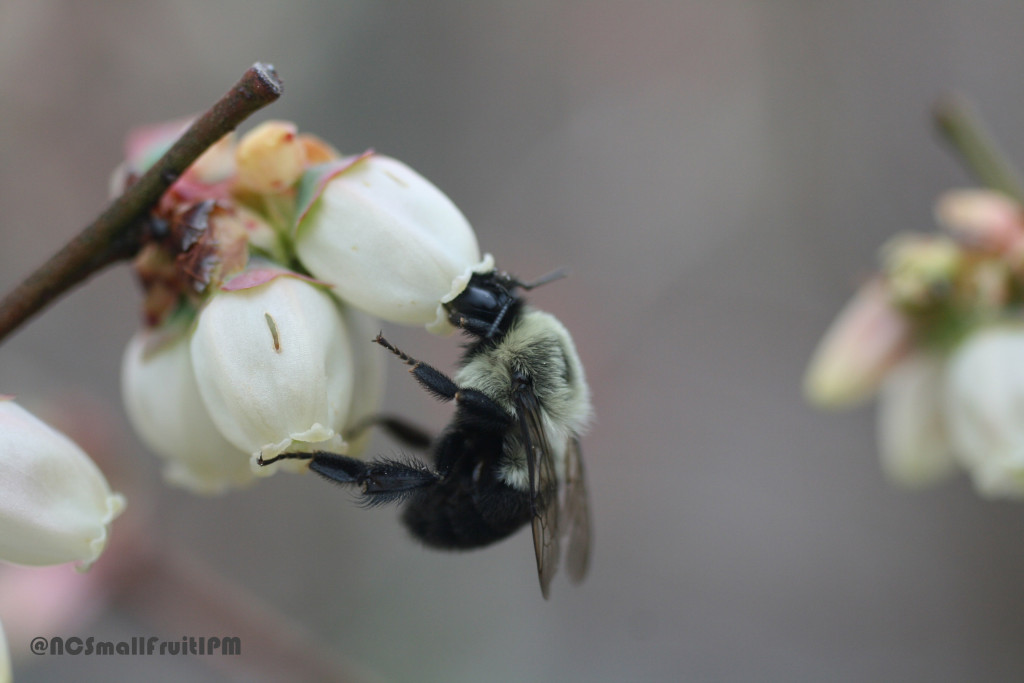
Bumble bee foraging at a blueberry flower. Photo: HJB

We've posted lots of information about blueberry pollinators at the Entomology Portal, including results from our experiments over the last several years.

Which bees are the best blueberry pollinators?
Does bee diversity change how pollinators behave in blueberries?
Blueberry pollinators - Information on different bee species

Sunday, May 27, 2012

Upcoming pollinator presentation at NC State

Honey bees and native pollinators active in early summer blooms. Raleigh, NC. Photo: HJB
My backyard was a pollinator paradise this morning. Carpenter bees, bumble bees, honey bees, and lots of small native bees were active at our salvia, hydrangea, and kniphofia.  All these bees reminded me that I wanted to share that Shelley Rogers will be defending her master's thesis on pollination ecology in North Carolina blueberries this Tuesday, May 29th at 9am in 3503 Thomas Hall on NC State's campus.  Shelley has done an outstanding job of describing the pollinator community, individual pollinator efficiency, and some of the unique bee interactions specific to blueberries in the southeast.  She'll be sharing the results of this effort Tuesday, and her presentation is open to the public.

Carpenter bee foraging on salvia. Photo: HJB

Thursday, April 26, 2012

What causes misshapen strawberries?

Recently, I've gotten a few questions about misshapen strawberries.  Misshapen or "wonky" strawberries can be caused by several things, but the two most common causes likely to occur in North Carolina are poor pollination and lygus bug injury.  It's actually fairly straightforward to distinguish between these two types of injury.

Poor pollination
Strawberries do not require, but benefit from, insect pollination, so weather conditions that limit insect activity and pollen movement typically precede when this type of misshapen fruit appears.

Misshapen strawberry fruit due to poor pollination (above) and a normal appearing fruit (below). Photo: HJB
Poor pollination causes misshapen fruit because unfertilized seeds remain small and the fruit around them does not grow at the same rate as the fruit around fertilized seeds.  On the image above, the top fruit has seeds of different sizes next to each other while the seeds on the bottom fruit are uniform.

Lygus bug injury
North Carolina Department of Agricultural (NCDA) regional agronomist David Dycus mentioned via email today that growers in Mississippi had recently expressed concern about misshapen fruit due to lygus bug feeding.  Lygus bugs (also known as tarnished plant bugs) feed on strawberry seeds and fruit and can also cause misshapen fruit.  Lygus feeding does not result in variable seed size and can, therefore, be distinguished from poor pollination in strawberries.  Typically, North Carolina growers do not experience extensive damage from lygus bugs, because they are active later in the year.  This year, however, they may be active earlier (although, our warm spring has turned a little chillier), and it's worth keeping an eye for their damage.  Lygus can be difficult to control, so if grower suspect they have damaging populations of lygus present, they should contact their county agent or myself for recommendations.
Strawberries damaged by lygus bugs. Photo: UC IPM Program
Other, non pest, insects can look like lygus bugs, include beneficial insects like big-eyed bugs and non strawberry pests insects like false chinch bugs, and it's important to correctly identify pests.  BugGuide has a nice identification guide for Lygus lineolaris (the east coast species which feeds on strawberries).

Other causes of misshapen berries
Insects and poor pollination are not the only causes of misshapen fruit in strawberries. Pathogens can damage fruit, mechanical injury can scar it, and abiotic factors can change fruit shape.

Update, 27 April 2013
An update to this post has been added to the NCSU Strawberry Growers Information Portal.
Thursday, March 29, 2012

What to watch for: caterpillars everywhere!

Caterpillar feeding on developing blueberry buds. Photo: Bill Cline
Worms or caterpillars, whatever you prefer to call them, there is an bumper crop of larvae in North Carolina this spring.  My colleague, Steve Frank, ornamental and urban horticulture entomologist, spoke to the Raleigh News & Observer this week about about the large number of cankerworms present in state, and this afternoon, I received calls about caterpillar damage in two crops, blueberries and strawberries.  The abundant caterpillar populations are likely due to warm spring weather; many insects have been able to begin an early generation. In blueberries, this has resulted in isolated pockets of large numbers of what appear to mixed populations of spanworms, cankerworms, and other generalist caterpillars.

A diverse assortment of caterpillars from southeastern North Carolina blueberries. Photo: Bill Cline.
 One grower who has noticed large caterpillar populations in Reveille, a later flowering variety, and asked plant pathologist Bill Cline what the potential management options might be.  In the past, blueberries grower may have used malathion, a broad spectrum insecticide, applied in the late evening to control caterpillar populations.  I instead suggest that the grower use a narrow spectrum material that is safer to bees, as the plants to be treated were close to bloom.  Regardless of how safe a pesticide may be for bees, if plants are to be treated during bloom, any material should be applied in the evening minimize exposure to bees and allow for maximum dry time before they begin foraging.

The second question was from a research station in Virginia, where they had noticed green caterpillars present in their ripening strawberries.  My suggestion for strawberries would be the same--select a narrow spectrum, bee safe material.  These would include microbial (such as Bt) or insect growth regulators (such as Intrepid). See a note on pesticide recommendations.  Following any treatment, plants should be carefully scouted for re infestation, since high insect pressure situations may result in more movement into crops.  Just because caterpillars are present in a crop again following treatment does not necessarily mean that the treatment did not work.  Insects can also move back into plantings following a treatment.

Wednesday, October 26, 2011

It's meeting season!

The field season is reaching its end, and meeting season is set to begin!  I will have posts for each of the meetings where I will be presenting, but there's too many additional meetings to list separately!  Here are several of upcoming meetings, workshops, and conferences:

Pollinators
Pollinator conservation planning short course. Organized by Xerces Society. November 15th. Mills River, NC.
Pollinator conservation planning short course. Organized by Xerces Society. November 17th. Pittsboro, NC.

Strawberries
Southeast Strawberry Expo. Organized by the North Carolina Strawberry Association. November 6-8. Durham, NC.

Grapes
North Carolina Winegrape Growers Annual Conference. Organized by the North Carolina Winegrowers Association. February 3-5, 2012. I will be presenting at this meeting on November 5th.

General & sustainable agriculture
Rockingham County Small Farm Day. Organized by Rockingham County Cooperative Extension. November 5. I will be presenting at this meeting.

Sustainable Agriculture Conference. Organized by Carolina Farm Stewardship Association. November 11-13. Durham, NC. Including a session on hops production by Scott King, NCSU Soil Science Department.

Crop Protection School. Organized by the North Carolina State University College of Agriculture & Life Sciences. December 6. I will be presenting on spotted wing drososphila at this meeting as part of a session on new invasive species in North Carolina.

Southeast Regional Fruit & Vegetable Conference. Organized by the Georgia Fruit & Vegetable Growers Association. January 5-8, 2012. I will be presenting at this meeting on insect monitoring & management in muscadine grapes, spotted wing drosophila in blackberries & raspberries, and spotted wing drosophila in blueberries.  Whew!

Wednesday, June 30, 2010

NCSU Apiculture on WBUR

David Tarpy, a bee biologist at NCSU, was featured recently on an episode of On Point, a public radio show produced by WBUR Boston, discussing the rise in backyard beekeeping interest.

You can listen to the entire show here.

Wednesday, May 26, 2010

National Pollinator Week


National Pollinator Week is June 21-27th.  This is an opportunity to learn more about the insects (and some vertebrates) that make our fruits and vegetables possible.  Pollinator Week events in NC include the Johnston County Pollinator Festival at the Howell Woods Environmental Learning Center on June 26, 2010 from 9:00 am to 4:00 pm. Events include pollinator garden tours, crafts, making bee nesting bundles, visiting with vendors and beekeepers, “What’s The Buzz on Native Pollinators?” classes and beekeeping presentations. Join them for one program, or come out for the whole day. Bring a picnic lunch, see the live animal exhibits, explore the nature trails and experience the beauty of Howell Woods. There is no charge for this event. Howell Woods Environmental Learning Center is located at 6601 Devil’s Racetrack Road, Four Oaks, NC 27524. For more information contact Katrina McDougald at mcdougaldk@howellwoods.org or (919) 938-0115 ext. 115. Find out more about Howell Woods at www.howellwoods.org. 


Our lab has developed a strong interest in pollinator diversity and efficiency in the last 2 years.  Shelley Rogers, a MS student co-advised by David Tarpy and I, is studying the pollination ecology of the southeastern blueberry agroecosystem.  Shelley and I will be sharing the preliminary results of this work at the the North American Blueberry Research & Extension Workers Conference in July.  We are hoping to expand our pollinator work to include other production systems, including caneberries, who's pollination needs and pollinators we know little about.


Tuesday, March 16, 2010

NABREW meet in Michigan, July 25-28, 2010

The North American Blueberry Research & Extension Workers Conference will be held in Kalamazoo, Michigan July 25-28th. This meeting will highlight work in entomology, horticulture, and plant pathology, and presentation abstracts are due April 1st. Details about abstract submission and the meeting can be found at the NABREW webpage.

I will be attending and plan to present some of our preliminary pollinator findings from NC.

Thursday, March 4, 2010

Blueberry pollination site visits begin


My colleague, David Tarpy, and I are beginning a project studying blueberry pollinator diversity and abundance in the southeast, lead by masters student Shelley Rogers, and this week Shelley conducted the first site visits. Our locations span the state and include conventional, organic, commercial, and unmanaged sites.

We have experience a record number of chilling hours this winter, which means bloom will be concentrated this spring.

O'neal, one the early blooming varieties was already pushing buds this week, which means we have about 2 weeks before pollinator assessments begin in earnest. The goal of this project is to determine which pollinators are most abundant and efficient in our blueberry agroecosystem and what landscapes are most conducive to these insects. This project will run for 2 years and encompass at least 14 locations and supported in part by the NC Blueberry Council.

Thursday, February 4, 2010

Blueberry pollination sites being sought

In 2009, we began a multi year project to assess pollinator diversity and efficiency in southeastern blueberries. Although excellent work has been done Georgia, Mississippi, and Michigan blueberry production systems, the mid southeast (NC, SC, and VA) differ both in climate and production system. The vast majority of blueberries grown commercially in NC are southern highbush, while in GA, mostly rabbiteye varieties are grown. Bloom phenology and flower morphology differ between these species, and its reasonable to assume that pollinator interactions may differ as well.

Observations in 2009 highlighted the differences between southern highbush and rabbiteye blueberries. In 2010 and 2011, we will be conducting detailed, on farm observations of pollinator diversity and abundance, primarily in NC. We are currently seeking grower cooperators who are interested in participating in this project. Grower participation will entail allowing us to sample and observe pollinators, allowing caging of ~50 branches prebloom, and allowing sampling of ~1000 fruit. Interested growers can contact Hannah Burrack with questions or to get involved.

This project will also include video capture of pollinators in action, which will be shared online (including here), starting Fall 2010.

Followers