Search NC Small Fruit, Specialty Crop, and Tobacco IPM

Showing posts with label biological control. Show all posts

Thursday, March 8, 2012

What to watch for: A preemptive question about mites and hops

Hop yard in western NC, July 2010 Hop Tour. Photo: HJB
With the news that Sierra Nevada Brewing Company is opening a facility in Mills River, NC, interest in North Carolina hop production has again surged.  I think we still have a lot to learn about the feasibility of growing hops in North Carolina, but several, mostly small scale producers are already active.  One of these growers emailed me today asking about their main arthropod pest, spider mites, and what action she might take to prevent large populations developing this year.  Last year, she released two predatory mite species, Neoseiulus fallacis and Phytoseiulus persimilis, and she was wondering if those populations could overwinter and be relied to provide control this year. 

Hops leaves respond to relatively low mite densities.  The yellow stippled area on this leaf had a population of spider mites feeding on the opposite side. Photo: HJB
 My reply: "We have native populations of N. fallacis in the western NC mountains, so it is reasonable to assume that they should be able to overwinter (although lab reared mites may be less adapted to winter conditions).  We have had success overwintering P. persimilis under high tunnels on strawberries, but I can't say how well it will do out in the open.

The only way to know if your mites from last year have stuck around is to look for them. Sample 10 leaves per variety weekly and observe with a minimum 10x hand lens.  It will take some practice, but you can see and count mites with a hand lens.  You can distinguish predatory mites from pest mites by size (they are smaller), shape (most are tear drop shaped or oval), and color (P. persilimis) is orange.  Predatory mites also move much faster than pest mites. See here for images of some of the predatory mites commonly used for biological control. Start sampling when you have new leaves and continue weekly.  When and if you release additional predatory mites will depend on when spider mite pests appear in your planting."

Tuesday, May 24, 2011

Insect activity beginning in the research hop yard


Caterpillars feeding on a hops leaf at the Lake Wheeler Field Laboratory. Photo: HJB

Yesterday, undergraduate intern Mandi Harding and I visited the research hop yard at the NC State Lake Wheeler Field Laboratory to check the traps we placed last week, collect mite & aphid samples, and observe any insect activity. The plants are just starting to reach to the top of the trellis, so I didn't necessarily expect large insect populations. I was correct in that there was minimal activity, but we did see some notable insects eating hops or eating other insects that were eating hops. Several plants had recently hatched caterpillars (see above) present, and they all appeared to be the same species. Rather than collecting these larvae and rearing them in lab, we are going to keep an eye on them in the field and collect them when they are closer to pupation.

There were also plenty of beneficial arthropods (insects and mites) present, including lady beetles, predatory mites, minute pirate bugs, and lightning bugs (which are actually beetles and are one of my favorite things about living east of the Mississippi). Thrips were clearly visible crawling on leaves and inside cones. Thrips are potential pests of hops in the southeast, and I am always amazed at the sheer number of thrips present in the early summer in North Carolina. I am even more impressed when I talk to cooperators on research projects in the Pacific Northwest who catch on the order of 10-15 thrips per trap, and we catch 0ver 300 in the same time period. Thrips seem to thrive here, for better or worse. Also thriving are thrips predators, like the lightning bug (beetle) below.

A lighting bug feeding on thrips on a hop leaf. Click here to enlarge this image for a better view of the distinctively striped soybean thrips highlighted. Photo: HJB

We'll be collecting samples and observing insect populations in the hops yard throughout the summer and will post updates when interesting insects appear.

Wednesday, May 26, 2010

First lightning bugs of the year!

On my drive home last night, I saw my first lightning bug (or firefly) of the year.  Tonight as I walked back from dinner, there were even more active. Fire"fly" or lightning "bug" are both misnomers, as the insects in question are actually beetles in the family Lampryidae.


Fireflies are one of the (many) reasons I am glad to be back east of the Mississippi.  They do not occur in California, where I did graduate work, and summer just isn't summer without them!

Fireflies can also be important predators, as they feed on soft bodied larvae and adults of other insects.  In fact, I have seen fireflies rooting around in blackberry blossoms, presumably in search of larval thrips to eat.  I suspect the plant actually receives some pollination benefit along the way.

Tuesday, February 9, 2010

The down side of tunnels

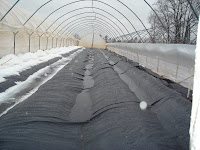
Tunnel 4 at the Piedmont Research Station, Salisbury, NC on Friday, February 5th.

We have been assessing the overwintering ability of predatory mites in high tunnel strawberry plots for the last 2 winters with the goal of optimizing organic management recommendations. There is a local and wholesale market for high quality winter strawberries, and several growers have begun to take advantage of this. Among theses grower is Sonny Cottle, in Faison, NC, who has produced organic strawberries in high tunnels for several years and has experimented with predatory mites and other organic twospotted spider mite management methods.

There are a lot of benefits to working in tunnels. We never have to worry about getting rained out from a miticide treatment (or a harvest), it's usually a balmy 50 degrees in the winter, and, not the least, the Piedmont Research Station personnel are top notch. However, this year has provided a primer in the challenges of tunnel production.

The differences between seasons were apparent immediately. TSSM reached threshold in the 2009 season in mid November (2008), and predators were released soon after. Our 2010 tunnel was adjacent to caneberry plots, and the spider mites migrated into our strawberries right after transplant. Our first predator release in 2010 season was in mid October (2009), and was less successful in suppressing an already large TSSM population. A second release was conducted in November (2009) which provided greater suppression.

The winter of 2009 was excellent for tunnel production--cool, but moderate temperatures, and only one snow storm to content with. We had one significant cold event in January which required irrigated frost protection, but row cover was sufficient for the remainder of the season. In 2010, we have experienced one the coldest winters in recent memory. Row covers have been in place almost every day for the last 2 months, which, unfortunately, has lead to extensive predatory mite movement between plots. We can still gather data on our primary objective, determining the ability of predatory mites to overwinter and reproduce in tunnels, but our release plots are no longer contained.

Our latest challenge has been snow. Although it was nothing compared to the recent storms in Washington, D.C., North Carolina had its share of snow the last weekend in January 2010. The 5 inch accumulation was enough to warrant the removal of our tunnel's (Tunnel 4) plastic skin to prevent collapse. As of today, our plants are covered with black plastic and row cover, and the tunnel is uncovered. Plans are to get the plastic back up today (Tuesday, February 9th), and we intend to sample Thursday to see what the impacts on TSSM and our predators are.

There's never a dull moment in agriculture--even in the "off" season!

Sunday, October 25, 2009

Meet the predators


Last Wednesday (10/21/09), we released our predatory mites into our twospotted spider mite biological control plots at Piedmont Research Station. Two weeks ago, we treated all our buffer plots with miticide and we treated again about 1 hour before releasing the mites. This strategy worked will last year; we were able to maintain populations in our untreated control plots while suppressing populations in our predator release plots without noticeable movement between them. This year our spider mites showed up about a month earlier than last year, so we'll see if this same methodology works for smaller, younger plants that have a lot of growing left to do. The spider mite populations were so high, however, that waiting to release predators would have jeopardized the trial.

We released 20 predators/plot (that's 1/sq ft). This is higher than field rates, but for the sanity of the mite counter (me) 20 is as low as I wanted to go. Each species was released alone in a plot. Last year, we combined some predators (like in this trial) but our main goal this winter is to see which, if any, of the species released remain active in the protected environment of the tunnels over the winter. We know the spider mites do--less than 10% of the twospotted spider mites observed last winter were diapausing at any given time, and eggs were present all winter long in the tunnels.

The three predator species we released are the same as last year, and 2 have been used commercially in field grown strawberries for a while. (All the photos are from UC IPM, I need to get a camera for my microscope...)

Phytoseiulus persimilis (next to a female twospotted spider mite and her eggs) has been used in strawberries pretty extensively. We don't appear to have an established population in NC, but in parts of California, they move into strawberry fields on their own.

Neoseiulus (Amblyseius) californicus has gained in popularity in the last 10 years for use in strawberries. This is likely thanks to work done in Florida and the Pacific Northwest that has demonstrated its ability to reduce spider mite populations alone and in combination with P. persimilis.

Finally, Neoseiulus fallcis were released. These mites occur in North Carolina, and according to Jim Walgenbach (On Wisconsin!) in our department, they are also found in apple orchards feeding on European red mite. The fact that these guys like cool, humid weather best was the basis for including them in this trial, although they are not widely used in strawberries.

All of our mites were from Rincon-Vitova Insectaries. There are several other suppliers as well, but we could get all 3 of the mites used from them, which will hopefully minimize variability. We do our first post release count next week.

Followers