Search NC Small Fruit, Specialty Crop, and Tobacco IPM

Showing posts with label blueberry. Show all posts

Wednesday, December 18, 2013

Blueberry pollination posts at the NCSU Entomology Portal

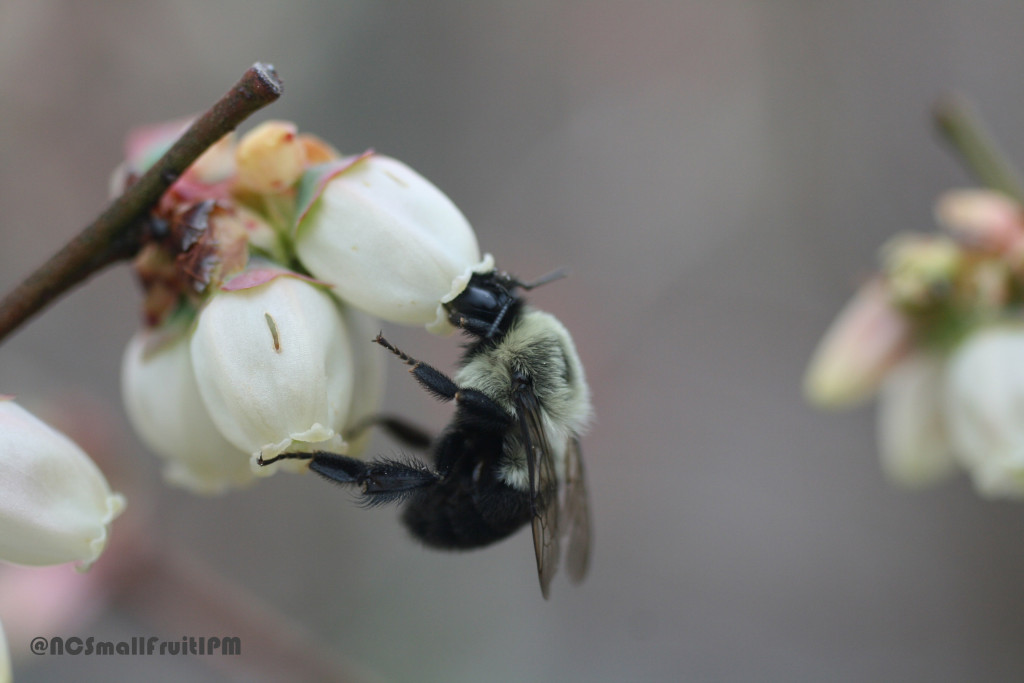
Bumble bee foraging at a blueberry flower. Photo: HJB

We've posted lots of information about blueberry pollinators at the Entomology Portal, including results from our experiments over the last several years.

Which bees are the best blueberry pollinators?
Does bee diversity change how pollinators behave in blueberries?
Blueberry pollinators - Information on different bee species

Wednesday, April 24, 2013

More thoughts on SWD trapping for 2013: How many traps should growers use?

After hearing several permutations on a similar question this week, namely "how many spotted wing drosophila (SWD) traps do I need to use?", I posted this information on the Strawberry Growers Information Portal.

More information
More on spotted wing drosophila monitoring: How many traps should growers use? - Strawberry Growers Information Portal

Friday, January 4, 2013

Spotted wing drosophila biology and mangament in blueberries

Our final spotted wing drosophila (SWD) factsheet for the year focuses on blueberries.  Please note, factsheets are shared via Google Documents, which is great for quickly and easily posting files but does sacrifice image quality.  If you would like a printer quality digital copy of this factsheet. Please email me.

You can find the first factsheet on SWD biology and management in North Carolina caneberries here, the second on post harvest SWD significance and sampling here, the third on SWD in strawberries here, and the fourth for home gardeners here.


Friday, August 31, 2012

Welcome, Bill Cline!

Bill Cline describing Blueberry Stunt, Red Ringspot Virus, & Stem Blight the 2011 Blueberry Field Day. Photo: HJB
As you may have noticed below, NC State Plant Pathologist and overall blueberry expert, Bill Cline has joined the blog and will be posting updates on blueberry insects.  Bill is much closer to the heart of North Carolina blueberry production than I am, so I am excited that he will be able to share insect sightings as they happen.

Friday, August 24, 2012

Flea beetle damage on blueberries

Flea beetle damage has been observed on unsprayed blueberry plots at the NCSU Horticultural Crops Research Station in Castle Hayne.  Feeding is mostly on new succulent shoots that have emerged following post-harvest summer pruning (hedging), so these are next year's bearing shoots that need to retain their leaves in order to set flower buds for the 2013 crop. Much of the damage is cosmetic, but where shoots are completely defoliated, or the shoots themselves are eaten, yield will be reduced in 2013.


 Flea beetles are rarely a problem on blueberry in North Carolina, but are more widely observed (and reported) on blueberry in Florida and Georgia.


Sunday, May 27, 2012

Upcoming pollinator presentation at NC State

Honey bees and native pollinators active in early summer blooms. Raleigh, NC. Photo: HJB
My backyard was a pollinator paradise this morning. Carpenter bees, bumble bees, honey bees, and lots of small native bees were active at our salvia, hydrangea, and kniphofia.  All these bees reminded me that I wanted to share that Shelley Rogers will be defending her master's thesis on pollination ecology in North Carolina blueberries this Tuesday, May 29th at 9am in 3503 Thomas Hall on NC State's campus.  Shelley has done an outstanding job of describing the pollinator community, individual pollinator efficiency, and some of the unique bee interactions specific to blueberries in the southeast.  She'll be sharing the results of this effort Tuesday, and her presentation is open to the public.

Carpenter bee foraging on salvia. Photo: HJB

Thursday, April 12, 2012

Spotted wing drosophila adults trapped in North Carolina blueberry country

Spotted wing drosophila (SWD) detections have begun earlier this year than in the previous two years the Spotted Wing Drosophila Volunteer Monitoring Network (SWD*VMN) has been active.   Now in addition to positive detections in Surry, Randolph, and Rowan Counties, SWD has been detected in southeastern North Carolina blueberries for the first time this year.

On April 5th, five male and five female SWD were captured in traps at the Horticultural Crops Research Station near Castle Hayne, NC. This site is New Hanover 1 in SWD*VMN, and you can see data from last year here.  You'll notice that last year, we caught our first fly here on May 9th, a full month later than our first capture this year.  You can see all the trap captures from this site, including those from last week and all future dates here.

What do these trap captures mean for growers in North Carolina?
The fact that we are catching flies at several locations throughout the state means that SWD are active.  This means that growers should be vigilant for both SWD adults and larvae on their farms.  Growers are strongly encouraged to monitor for SWD adults using the same traps we are using (learn how make and use SWD traps here and here).  However, we don't have a good handle on how trap captures relate to fruit infestation, which means that growers should also monitor fruit carefully (learn how to sample fruit and identify Drosophila spp. larvae here).  If SWD are present on your farm, we are currently recommending a fairly aggressive management strategy, because there is zero tolerance for larvae present in marketed fruit. Contact your county cooperative extension agent or Hannah for SWD management recommendations.

The SWD*VMN is supported by the North Carolina Tobacco Trust Fund Commission, Inc. and the NC Specialty Crop Block Grant Program.


More information
Insect monitoring in NC Blueberries - 2011
Spotted wing drosophila adult trapping data - New Hanover 1
SWD*VMN

Thursday, March 29, 2012

What to watch for: caterpillars everywhere!

Caterpillar feeding on developing blueberry buds. Photo: Bill Cline
Worms or caterpillars, whatever you prefer to call them, there is an bumper crop of larvae in North Carolina this spring.  My colleague, Steve Frank, ornamental and urban horticulture entomologist, spoke to the Raleigh News & Observer this week about about the large number of cankerworms present in state, and this afternoon, I received calls about caterpillar damage in two crops, blueberries and strawberries.  The abundant caterpillar populations are likely due to warm spring weather; many insects have been able to begin an early generation. In blueberries, this has resulted in isolated pockets of large numbers of what appear to mixed populations of spanworms, cankerworms, and other generalist caterpillars.

A diverse assortment of caterpillars from southeastern North Carolina blueberries. Photo: Bill Cline.
 One grower who has noticed large caterpillar populations in Reveille, a later flowering variety, and asked plant pathologist Bill Cline what the potential management options might be.  In the past, blueberries grower may have used malathion, a broad spectrum insecticide, applied in the late evening to control caterpillar populations.  I instead suggest that the grower use a narrow spectrum material that is safer to bees, as the plants to be treated were close to bloom.  Regardless of how safe a pesticide may be for bees, if plants are to be treated during bloom, any material should be applied in the evening minimize exposure to bees and allow for maximum dry time before they begin foraging.

The second question was from a research station in Virginia, where they had noticed green caterpillars present in their ripening strawberries.  My suggestion for strawberries would be the same--select a narrow spectrum, bee safe material.  These would include microbial (such as Bt) or insect growth regulators (such as Intrepid). See a note on pesticide recommendations.  Following any treatment, plants should be carefully scouted for re infestation, since high insect pressure situations may result in more movement into crops.  Just because caterpillars are present in a crop again following treatment does not necessarily mean that the treatment did not work.  Insects can also move back into plantings following a treatment.

Sunday, February 12, 2012

Larvae in fruit: distinguishing between spotted wing drosophila and other internally feeding fruit pests

It finally feels like winter in North Carolina, which may seem like a strange time to talk about pest of ripe fruit.  However, this morning I answer what I expect to be the first several questions from a homeowner who had "lots of maggots" (we prefer to use the term larvae here) in their fruit last summer and wanted to be prevent the same issue from occurring this year.  In this case, the homeowner was growing blueberries and was searching for tools to monitor and manage blueberry maggot.

Before 2010, it would be reasonable to assume that blueberry maggot (Rhagoletis mendax) larvae would be the most likely insect to be present in infested ripe blueberries grown in North Carolina.  However, the establishment of spotted wing drosophila (SWD) throughout the eastern US means that it is no longer safe to assume that fly larvae found in blueberries (or blackberries, raspberries, strawberries and other soft skinned fruit) are native insects and not SWD.  It is important to correctly identify which pests are present in commercially or home grown fruit because the management strategies for pest species will differ.  If you suspect that you have either of these insects in your fruit, contact your county cooperative extension agent or myself

I posted this summer about insects that might be present in "funny looking" blueberries and included information and links about two caterpillar pests of blueberries, cranberry and cherry fruitworms.  I'm not going to review the distinctions between these pests and fly larvae except to reiterate that if a larvae has legs (even if they are tiny), it is not one of our fly pests.

In order to determine if you have fly larvae present in your fruit, collect a minimum of 30 ripe, sound fruit.  If you are growing more than one variety or species of fruit, collect a separate sample from each.  It is essential that only sound fruit be sampled. If you would not eat a fruit, don't sample it!  Lots of non pest insects will feed on overripe, damaged, or rotting fruit, and sampling this fruit may lead you to conclude that you have a problem when you actually do not.  You should never make management decisions based on a crop you wouldn't eat or sell.

Once you have collected your sample, there are several ways you can determine whether the fruit are infested.  These include simply dissecting or crushing the fruit and looking for live larvae.  If you have a relatively small number of samples and good eyes (or a hand lens), this is the easiest method.  However, fruit dissection can be time consuming when you have a large number of samples, and it is possible to miss larvae if you do not look carefully. SWD researchers at Oregon State University have posted a video detailing the fruit dunk sampling method here. This method involve freezing the samples, which causing larvae to exit fruit and then floating the frozen fruit away from the larvae, which can be observed in the bottom of your container.  Finally, salt or sugar solutions can be poured over gently crushed fruit, which encourages the larvae to exit.  When conducted in over a dark surface, it's easy to see larvae moving.  Protect US, an invasive species detection and monitoring program headquartered out of the University of Florida, has a posted videos describing the salt and sugar tests here.

All of these tests will help you determine if you have larvae in your sample but not what the larvae are. If you find fly larvae in sound, otherwise harvestable blueberries, they are most likely either blueberry maggot or SWD.  These two different pests can be distinguished from one and other based on shape and size.  Shape is the most reliable differentiator between these two pests.  Blueberry maggot larvae are "carrot-shaped". Their head end, with dark mouth parts often visible, is tapered to a point and their rear end, with six, light brown spiracles (breathing holes; in two rows of three) is flattened. Larvae of all Drosophila spp., including SWD, are tapered on both ends, with their breathing tubes coming to a point at their rear end.

Larva of "true" fruit flies (Tephritids), which include the blueberry maggot fly, cherry fruit fly, and many others (top); larva of "vinegar flies" (Drosophilids), which include spotted wing drosophila and many native species (bottom). 
SWD and blueberry maggot larvae may also be distinguished by size.  A full grown blueberry maggot larva will be roughly twice as large as a full grown drosophila larva.  However, a middle aged blueberry maggot larva will be similar in size to a SWD larva, so shape is a more reliable tool.

Spotted wing drosophila larvae in ripe yellow raspberry, a closer detail in upper left hand corner. Photo: HJB
Blueberry maggot larva inside a blueberry.  Note that the larva is in motion and not always curled in a c-shape. Photo: Shawn Banks, Johnston County Cooperative Extension.
You can trap adult blueberry maggot and SWD as well.  If you are trapping before fruit are ripe, catching adults may provide you with a warning that these insects are present before you find larvae in fruit.  I provided DIY instructions for blueberry maggot and SWD trapping last summer.


More information
Do it yourself - Spotted wing drosophila monitoring
Do it yourself - Blueberry maggot monitoring
Protect US - YouTube Channel
Oregon State University Spotted Wing Drosophila Site
Michigan State University Spotted Wing Drosophila Site
Friday, July 8, 2011

NCSU PDIC blogs about funny looking blueberries


Cranberry fruitworm damaged blueberries. When several (3 or more) berries are damaged and large amounts of frass are present, it's likely that the fruitworm larvae have already exited the fruit to pupate. Photo: Bill Cline

Bill Cline, NCSU blueberry and muscadine pathologist, has posted a nice summary of some of the causes of "funny looking" blueberries in the southeast at the NCSU Plant Disease & Insect Clinic blog. Among the pathogens & mechanical injuries described is one type of insect damage, cranberry fruitworm (above). I wanted to add two more funny looking blueberry issues to the list.

Cherry fruitworm injury on ripe and unripe blueberry fruit in Bladen County, NC. 7 May 2010. Note entry hole on unripe fruit. The other fruit on this branch appear uninfested. Photo: HJB

Cherry fruitworm
Cherry fruitworm (Grapholita packardi) are similar to cranberry fruitworm, in that they feed internally on blueberries. Unlike cranberry fruitworm, however, cherry fruitworm feed on only 1 to 2 berries, and there is no visible frass outside the fruit. The injured fruit are often stuck together where the larvae exited one and entered the other. The fruit which was damaged first (on the right in the photo above) ripens early and will often fall off the bush if it rains before harvest. Cherry fruitworm may be present in fruit at harvest, and the pink to red larvae will exit the fruit if it is chilled. You can read more about cherry fruitworm here.

Blueberry maggot
Blueberry maggot larvae feeding internally in ripe fruit, July 2011. Photos: Shawn Banks, Johnston County, NC Horticulture Agent.

The third most common internally feeding blueberry insect in North Carolina is blueberry maggot (Rhagoletis mendax). We run a large scale blueberry maggot monitoring program throughout North Carolina's commerical blueberry growing counties (see our trapping data here), and blueberry maggot populations are extremely low in these areas. For the last 3 years, however, I have gotten reports of blueberry maggot damage in homeowner or small scale, direct market plantings. Blueberry maggot flies have one generation in NC, and the offspring from this year's flies start showing up around the beginning to middle of July (a little over one month after the first blueberry maggots are typically caught (25 May). Early ripening blueberries are at less risk of blueberry maggot attack. Ripening time in combination with the fact that blueberry maggot flies like to spend their time in large plants suggest that rabbiteye blueberries are at greater risk of blueberry damage. Blueberry maggot infested fruit will feel soft when picked, and the carrot-shaped larvae (approximately 1/2 inch long) will exit the fruit when chilled.

Blueberry maggot larvae can be distinguished from SWD (our new potential blueberry pest) by size: blueberry maggot larvae are 1/2 inch at their largest, while SWD are approximately 1/4 inch at their largest, and shape: blueberry maggot larvae are carrot shaped as illustrated above, and SWD larvae are more tapered at both ends.

More information
My blueberries look funny - NCSU PDIC Blog
NCSU Plant Disease & Insect Clinic Blog

Followers