Search NC Small Fruit, Specialty Crop, and Tobacco IPM

Showing posts with label DIY. Show all posts

Thursday, April 18, 2013

Spotted wing drosophila monitoring recommendations for 2013

Spotted wing drosophila traps in strawberry plots at the Horticultural Crops Research Station, Clayton, NC. Photo: HJB
Strawberries are just beginning to ripen in central North Carolina, so last week, we placed spotted wing drosophila (SWD, Drosophila suzukii) traps in our research plots at the Horticultural Crops Research Station in Clayton, NC.  Eagle eyed observers will noticed some differences in the traps in the photo above and those we placed in our SWD plots a few years ago.

Shading traps placed in strawberries
What's easily visible above is that our traps have "hats".  We added these hats because work from other labs suggested that SWD like shade and that leaving traps uncovered in strawberry plantings may catch fewer flies.  In a multistate comparison of SWD traps conducted in 2011, a trap with a "hat", referred to as the Haviland trap, caught more flies than other trap types in a range of different crops.  Hats are likely not necessarily in crops with shaded areas or where traps can be hung directly from host plants, like blueberries, cherries, and caneberries.

A Haviland-type SWD trap with a "hat".  In this case, the hat is meant to keep rain out. The Haviland trap performed well in a comparison of SWD traps during 2011.Photo: HJB

Bait recommendations
In previous years, we have used apple cider vinegar (ACV) as the primary bait in our SWD traps and for the SWD*VMN because early experiences suggested that it was easier to work with compared to a yeast & sugar slurry (the other bait we tested).  However, these early experiences were based on changing the baits less frequently than every week.  When baits are changed weekly, yeast & sugar lures appear to catch more flies and may catch flies earlier than ACV.  Therefore, for 2013, we're suggesting that SWD trappers consider using yeast & sugar lures rather than ACV.

In order to make the yeast & sugar bait, follow the steps below:

Ingredients for yeast & sugar slurry: yeast & sugar! Photo: HJB

1. Collect the bait ingredients, active yeast and plain sugar.


2. Combine 4 Tbsp sugar with 2 Tbsp yeast.


3. Add 32 fl oz of water to the dry ingredients and stir till the mixture is suspended. Do not store premixed bait in a sealed container.  It is actively fermenting (which is what attracts flies) and can explode.  It's easiest to mix bait as it's needed rather than premixing.


4. Fill traps with 150 ml of bait (or just over 5 fl oz) each.  Traps should be check and baits changed weekly.  The odors associated with these non preserved baits change over time, and after one week, they are likely less attractive to SWD.

A few other helpful hits for using yeast traps:

  • Many other insects find fermenting yeasts attractive. Traps should have small entry holes, no more than 3/16 large.  Otherwise, larger insects such as beetles, filth flies, and moths will clog traps.
  • Trap contents can be poured into a container for transport back to the office or lab rather than counted in the field.
  • Do not discard used bait in the field.  We do not want to make our fields any more attractive to SWD than they already are!
  • Kitchen sieves can be used to filter flies, but flies in yeast baits might need be rinsed after filtering to see wings, legs, and ovipositors (key ID characteristics) clearly. 

It's very likely that our bait recommendations will change for next year, based on experiments that are planned or already underway. SWD is an invasive species, meaning it's new to North Carolina, and many other areas. Therefore, many of our monitoring and management recommendations are subject to change.  We are all learning a lot of new information, as quickly as we can!

For the time being, we have not changed our trap recommendations. We are still suggesting using 32 oz plastic containers for 2013, although this recommendation is also subject to change, especially if commercially available traps become available that out perform homemade traps.

More information
Plan to monitor insects in 2013 - NC Small Fruit & Specialty Crop IPM

Monday, June 18, 2012

Do it yourself: take insect photos and collect samples for diganosis

I receive lots of emails from extension agents, growers, and homeowners requesting insect identification.  Oftentimes, these emails are accompanied by photographs of the insect, associated damage, or both.  Sometimes, these images are useful in determining what species, or more commonly, what general group of insects are responsible for the damage.  Most of the time, however, these images do not aid in insect identification and can even make it more difficult.

A group of entomologists from throughout the southeastern US have developed a series of training modules on basic insect identification, including Wiki pages, targeted to master gardeners, homeowners, and invasive species first detectors.  The First Detector Wiki describes how to identify some of the most common pest species as well as some of the most important invasive species spreading throughout the US.

More importantly for the budding entomological photographer, there are pages which cover the basis of how to properly photograph and submit images for digital diagnosis and how to collect and preserve insect samples for diagnosis.

The First Detector Wiki also includes information about some of the many pests in several insects orders.  Each of these order-level pages also includes information on how to take a good picture of members of that group.  For example, information to on taking a diagnostic photo of Dipterans (flies) is here.  The Diptera and Coleoptera (beetle) pages were developed by recent NC State Entomology graduate Matt Bertone in collaboration with myself and Mark Abney.

If you are interested in photographing insects for reasons beyond simple diagnosis, there are lots of amazing sites devoted to insect photography.  Some of my favorites are from Alex Wild (here and here) and Piotr Naskrecki (here).

More information
How to properly photograph and submit images for digital diagnosis - First Detector Wiki
Collecting insects - First Detector Wiki

Wednesday, May 23, 2012

Do it yourself: An update on distinguishing SWD larvae from other insects in strawberries

Early this spring, I wrote a post discussing how to distinguish spotted wing drosophila (SWD) larvae from other internally feed insects.  That post was focused primarily on blueberries.  This spring and early summer, however, I received several calls about SWD in strawberries, and they appeared in our research plots for the first time.

Fortunately, the majority of grower calls I received about larvae in strawberries ended up being sap beetle larvae rather than SWD larvae.  Sap beetles or picnic beetles are actually a complex of beetle pests which include at least three species in North Carolina (Carpophilus lugubris, Stelidota geminata, Glischrochilus quadrisignatus, and others) and are attracted to rotting, not sound fruit.  If rotting fruit are present near sound fruit, as can commonly happen when you-pickers aren't thorough or rain prevents picking, sap beetle adults and larvae can also attack sound, otherwise marketable fruit.

While sap beetle larvae are also not desirable in strawberries, they are more easily controlled than SWD.  Good sanitation, meaning removal of overripe or rotting fruit, is usually enough to keep sap beetle populations in check.

How, then, can you distinguish between sap beetle larvae and SWD?

Host fruit
Sap beetles will first attack overripe, rotting, or otherwise damaged fruit.  SWD will be found in fruit that appears otherwise marketable until cut open.  As SWD grow older, fruit condition may deteriorate, but fly larvae found in sound fruit are more likely to be SWD than those found in rotting fruit.

Size
Young sap beetle larvae may be similar in size to large SWD larvae, but in general they will be larger than SWD larvae.  Size on its own is not a good determinant, but it can be a good initial indicator.

Sap beetle larva on knife blade. Photo from a commerical strawberry farm in eastern NC, 2012.
 Appearance
SWD larvae lack legs, have no distinct head, lack hairs or bristles, and are tapered on both ends (see here for more images).  Sap beetle larvae have distinctive head capsules, three pairs of legs, and bristles along their bodies.  Adult sap beetles may also be present along with larvae.
Sap beetle larva. Note the three pairs of legs, the distinctive brown to black head capsule and the bristles along the body.  Sap beetle larvae will be mostly white or cream colored and lack patterns on their body. Photo from a commerical strawberry farm in eastern NC, 2012.

Two spotted wing drosophils larvae (center) inside a day neutral strawberry, Upper Mountain Research Station, October 2011. Photo: HJB
What other insects might be present inside strawberries?
Corn earworm (Helicoverpa zea) are occasional pests of strawberries, and the larvae can tunnel into berries.  Corn earworms are caterpillars, which means they have a distinctive head capsule and three pairs of front legs like sap beetle larvae, but they also have short, grippy prolegs along their abdomen and have a pattern of stripes along their body (although their appearance can be highly variable as larvae age).

Corn earworm larvae feeding on strawberries. Photo via UC IPM.

Sunday, February 12, 2012

Larvae in fruit: distinguishing between spotted wing drosophila and other internally feeding fruit pests

It finally feels like winter in North Carolina, which may seem like a strange time to talk about pest of ripe fruit.  However, this morning I answer what I expect to be the first several questions from a homeowner who had "lots of maggots" (we prefer to use the term larvae here) in their fruit last summer and wanted to be prevent the same issue from occurring this year.  In this case, the homeowner was growing blueberries and was searching for tools to monitor and manage blueberry maggot.

Before 2010, it would be reasonable to assume that blueberry maggot (Rhagoletis mendax) larvae would be the most likely insect to be present in infested ripe blueberries grown in North Carolina.  However, the establishment of spotted wing drosophila (SWD) throughout the eastern US means that it is no longer safe to assume that fly larvae found in blueberries (or blackberries, raspberries, strawberries and other soft skinned fruit) are native insects and not SWD.  It is important to correctly identify which pests are present in commercially or home grown fruit because the management strategies for pest species will differ.  If you suspect that you have either of these insects in your fruit, contact your county cooperative extension agent or myself. 

I posted this summer about insects that might be present in "funny looking" blueberries and included information and links about two caterpillar pests of blueberries, cranberry and cherry fruitworms.  I'm not going to review the distinctions between these pests and fly larvae except to reiterate that if a larvae has legs (even if they are tiny), it is not one of our fly pests.

In order to determine if you have fly larvae present in your fruit, collect a minimum of 30 ripe, sound fruit.  If you are growing more than one variety or species of fruit, collect a separate sample from each.  It is essential that only sound fruit be sampled. If you would not eat a fruit, don't sample it!  Lots of non pest insects will feed on overripe, damaged, or rotting fruit, and sampling this fruit may lead you to conclude that you have a problem when you actually do not.  You should never make management decisions based on a crop you wouldn't eat or sell.

Once you have collected your sample, there are several ways you can determine whether the fruit are infested.  These include simply dissecting or crushing the fruit and looking for live larvae.  If you have a relatively small number of samples and good eyes (or a hand lens), this is the easiest method.  However, fruit dissection can be time consuming when you have a large number of samples, and it is possible to miss larvae if you do not look carefully. SWD researchers at Oregon State University have posted a video detailing the fruit dunk sampling method here. This method involve freezing the samples, which causing larvae to exit fruit and then floating the frozen fruit away from the larvae, which can be observed in the bottom of your container.  Finally, salt or sugar solutions can be poured over gently crushed fruit, which encourages the larvae to exit.  When conducted in over a dark surface, it's easy to see larvae moving.  Protect US, an invasive species detection and monitoring program headquartered out of the University of Florida, has a posted videos describing the salt and sugar tests here.

All of these tests will help you determine if you have larvae in your sample but not what the larvae are. If you find fly larvae in sound, otherwise harvestable blueberries, they are most likely either blueberry maggot or SWD.  These two different pests can be distinguished from one and other based on shape and size.  Shape is the most reliable differentiator between these two pests.  Blueberry maggot larvae are "carrot-shaped". Their head end, with dark mouth parts often visible, is tapered to a point and their rear end, with six, light brown spiracles (breathing holes; in two rows of three) is flattened. Larvae of all Drosophila spp., including SWD, are tapered on both ends, with their breathing tubes coming to a point at their rear end.

Larva of "true" fruit flies (Tephritids), which include the blueberry maggot fly, cherry fruit fly, and many others (top); larva of "vinegar flies" (Drosophilids), which include spotted wing drosophila and many native species (bottom). 
SWD and blueberry maggot larvae may also be distinguished by size.  A full grown blueberry maggot larva will be roughly twice as large as a full grown drosophila larva.  However, a middle aged blueberry maggot larva will be similar in size to a SWD larva, so shape is a more reliable tool.

Spotted wing drosophila larvae in ripe yellow raspberry, a closer detail in upper left hand corner. Photo: HJB
Blueberry maggot larva inside a blueberry.  Note that the larva is in motion and not always curled in a c-shape. Photo: Shawn Banks, Johnston County Cooperative Extension.
You can trap adult blueberry maggot and SWD as well.  If you are trapping before fruit are ripe, catching adults may provide you with a warning that these insects are present before you find larvae in fruit.  I provided DIY instructions for blueberry maggot and SWD trapping last summer.


More information
Do it yourself - Spotted wing drosophila monitoring
Do it yourself - Blueberry maggot monitoring
Protect US - YouTube Channel
Oregon State University Spotted Wing Drosophila Site
Michigan State University Spotted Wing Drosophila Site

Saturday, June 25, 2011

Do it yourself - Grape root borer monitoring

Tomorrow, June 26, I will be kicking off the 2011 Grape Root Borer Volunteer Monitoring Network (GRB*VMN) at the NC Winegrowers Association summer picnic. I will be distributing trapping kits to volunteer growers and demonstrating trapping methods. For grape growers interested in monitoring for grape root borer who cannot attend the meeting, this post details how to monitor on your own. If you are interested in participating in the GRP*VMN, please contact me for more information.


The traps I use are available from Great Lakes IPM* and pheromone lures can be purchased from Arbico-Organics*.


Grape root borer (Vitacea polistiformis (Harris)) is potentially the most significant pest of grapes (both muscadine and Vinfera) in the southeast.  Larvae have a 1 to 2 year life cycle, which means that injury, in the form of weakened and dying vines, often does not present for several years.  Many of the Vinfera vineyards in the Carolinas and Georgia are reaching the 8 to 10 year mark, the time at which I anticipate grape root borer injury to become more apparent.


The GRB*VMN has two purposes:
1. To determine the density, range, and seasonal biology of grape root borer in North Carolina.  In other words, to find out how many moths we have in our vineyards, which vineyards they are present in, and at what time of year they are active.
2. To give NC grape growers the skills to monitor for grape root borer and make management decisions based on monitoring information.


To accomplish these goals, we will train grape growers throughout the state to monitor for grape root borer adults on their farms and share their data through this blog.


Monitoring methods
We will place 4 universal moth traps per vineyard.  Ideally, we will place these traps each in a different variety (if present).  Within variety blocks, traps should be placed in low lying, wet areas, since these are at the highest risk of grape root borer infestation.

Grape root borer trap components. From left to right: hanger, trap top, trap lid, pheromone container (front), pheromone impregnated septa (packet, front), pesticide kill strip (red, front), and trap bottom (back).
Traps should be assembled as follows:

Pesticide strips placed in trap bottom.
Pesticide strips are used to kill moths once they enter traps. No pesticide is present outside the traps, and therefore, these traps can be used in organic systems.  Pesticide strips should only be handled with nitrile gloves.

Trap top attached to bottom.

Trap tops snap onto to trap bottoms.
Trap lid added to trap top.
Trap lids keep rain and other debris out of the bottoms.

Grape root borer pheromone impregnated septa.
Grape root borer pheromones are impregnated onto rubber septa and remain attractive for an entire field season.

Pheromone lure placed in pheromone container.
Pheromone lures are placed into lidded containers.

Assembled trap.
The pheromone container is inserted in the trap lid and hangs into the trap opening.  Moths are attracted to pheromone lures and fall into the trap bottom where they are killed by the pesticide strip.  Hangers are attached to trap lids, and traps are hung from canes or trellis wires.

Assembled grape root borer trap
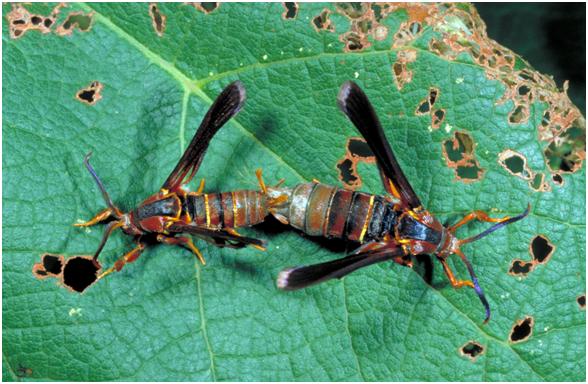
Traps are checked weekly  and moths are counted.  Pheromone lures are attractive at a long distance to male moths, and attractive at a short distance to females, so both sexes may be present in traps.  Grape root borer moths resemble wasps but differ in that their wings are black and they lack the thin "waist" of wasps.  After a few days in the traps, moths may appear darker brown (see below).
Mating male (left) and female (right) grape root borer moths. Photo: University of Kentucky.
Female grape root borer moth one week after collection.
While the grape root borer pheromone is relatively specific, it will attract one related species, the squash vine borer.  However, these moths are bright orange and black and easily distinguished from grape root borer.  Other insects found in traps may include beetles and small brown moths, but these should also be readily distinguishable from grape root borer moths.
Mating male (left) and female (right) squash vine borer moths. Photo: University of Minnesota
Data collected by the GRB*VMN will be entered online weekly and will be shared here, beginning the first week of July.

*Does not imply endorsement of named vendors over other options.

More information
NC Winegrowers Association - Summer Picnic

Wednesday, June 15, 2011

Do it yourself - Spotted wing drosophila monitoring

As we begin to find spotted wing drosophila (SWD) in more and more locations, growers and homeowners are expressing interest in monitoring for adult flies.  Our volunteer monitoring network uses simple, homemade traps that can be easily adapted for use by others. (Enlarge photos by clicking on them.)  

Trapping supplies include:
Apple cider vinegar (not "flavored")**
1 to 3 quart sized plastic containers with 10 to 12 1/4 inch holes one inch from the top
Unscented dishsoap
Forceps (not shown)
Sieve (not shown)
Solid containers (not shown)
Sorting tray (not shown)
Sample vials (not shown)

Yellow sticky cards (optional)
Cellophane (optional)
Microscope, magnifier, or hand lens (preferred)
**Update, 18 April 2013 - For 2013, we are suggesting that yeast & sugar baits be used instead of apple cider vinegar. Read about how to make and use yeast & sugar lures here.

Many of the trapping supplies can be either be purchased at the grocery store (the deli section will often let you have a few quart sized (32 oz) containers) or through online retailers.  I either use a soldering iron or a 1/4 inch drill bit to punch 12 holes in each trap.  I then string a hanger (nylon cord) through 2 opposite holes.  Yellow sticky cards, forceps, and magnifiers can be purchased from several sources*; I order ours from Great Lakes IPM or BioQuip.


Traps are baited with 1 to 2 inches of apple cider vinegar.

Yellow sticky cards increase the attractiveness of the traps, but also make it more difficult to distinguish female flies from native Drosophila spp.
Because yellow sticky cards improve trap attraction, we are using them at SWD volunteer monitoring network sites where we have not previously caught SWD.  However, because the yellow sticky cards complicate SWD identification & trap processing, we stop using them once SWD is confirmed at a location.


Traps should be hung directly from plants (blueberries, caneberries, grapes, fruit trees, etc.) or placed in the fruit zone of low growing plants (strawberries) near fruit.  SWD prefer shady areas with available moisture, so traps hung in these areas are most likely to catch flies.

This trap was hung from the trellis wire near a heavily fruiting blackberry plant.
Traps should be checked at least weekly.  If using yellow sticky cards, they should be removed, wrapped in cellophane, and marked with the date and trap number.

Sticky cards are only changed if suspected SWD are present or if they are no longer sticky.
A regular kitchen sieve (8 or 10 gage mesh) is small enough to prevent adult SWD from passing through.
Using a 8 to 10 gage mesh sieve (a standard kitchen sieve or sink strainer works well), filter apple cider vinegar into a solid container.

Be sure to line up the holes in the trap with the sieve to avoid spilling vinegar. 
After you have filtered the vinegar, return it to the trap and refill to 1 to 2 inches.  You can reuse the apple cider vinegar but should completely change it at least every 4 weeks.  Used apple cider vinegar should be discarded away from the field so as not to attract flies away from traps.  We are currently studying how long apple cider vinegar and other lures are attractive to SWD, so recommendations on reusing lures may change.

Replace traps after they have been refilled.  
Rinse collected insects off the sieve in to the solid sample container and return them to the office  or lab to process.
The collected insects should be compared to voucher specimens (right) or images of known SWD.
While male SWD are readily distinguishable with little or no magnification, female SWD are more difficult to identify.  Ideally, suspected female SWD (flies that are similar is size, shape, and color to voucher specimens) should be observed under 20x magnification.  The key distinguishing characteristic for female SWD is their large, serrated ovipositor.

The ovipositor of female SWD is large, serrated, and readily distinguished from native Drosophila spp.
Can you spot the male SWD?
Compare suspected SWD to known voucher specimens (available upon request from Hannah).
If you suspect that you have captured SWD adults, check your identification with your cooperative extension agent, extension specialist, the NC Plant Disease & Insect Clinic, or other experts.

Because we are still learning about SWD biology in North America (and the southeast), our current management recommendations are conservative.  I suggest the growers who capture SWD at their farm utilize pesticide treatments (either conventional or organic).  See here for a list of management tools available for North Carolina small fruit growers and their likely efficacy against SWD.  This list is only applicable to North Carolina growers.  If you are outside NC, consult your local cooperative extension agent for registered management tools.  You can find your local cooperative extension office here.

*Does not imply endorsement of named vendors over others.

More information

Sunday, May 8, 2011

Do it yourself - Blueberry maggot monitoring

I have received several questions from growers and homeowners about blueberry maggot monitoring and management over the last few weeks. As part of an ongoing research project, my lab continues to monitor blueberry maggot populations in North Carolina blueberry fields. Our methods were based on those accepted by the Canadian Food Inspection Agency, and can readily be used by growers or homeowners. This post details how interested growers and homeowners can monitor blueberry maggot populations in their blueberry planting.  You can learn about blueberry maggot biology here.

Note that all supplier links are provided for informational purposes. This information is not intended to endorse any particular supplier over another.

What will I need?
Yellow sticky traps (Trece AM-No Bait traps preferred)
Bulk ammonium bicarbonate and vials or "bait enhancers"


From left, bait enhancer vial, AM-No Bait Trap, and bulk ammonium bicarbonate.  Photo: HJB
How many traps do I need?
Trap number depends on the size of your planting. You should always use a minimum of 3 traps for plantings of 5 acres of less. For plantings larger than 5 acres, use the table below (adapted from the Phytosanitary Requirements for the Importation From the Continental United States and for Domestic Movement of Commodities Regulated for Blueberry Maggot, Canadian Food Inspection Agency):

Area of Blueberry Planting (Acres)
Number of Traps
5 or less
3
6-15
4
16-40
5
41-70
7
71-100
9
Over 100
9 + 1 trap for every additional 15 acres over 100

How do I place the traps?
Blueberry maggot traps should be hung in the upper third of blueberry bushes so that they are clearly visible.  Traps should be hung with the folded end pointed down and the opening upward.  Ammonium baits should be attached to the trap via a twist tie.  Previous research in North Carolina has demonstrated that blueberry maggot adults are more often trapped in large plants and shaded areas.  Therefore, large blueberry bushes with fruit present are preferred for trapping.  Some traps should also be placed near the edges of fields/plantings in weedy areas.
Blueberry maggot trap in blueberry planting in Rockingham County, NC. Photo: HJB
How do I check traps?
Traps should be checked a minimum of once per week, ideally twice per week.  At each trap check, you should also check the ammonium lure.  If you no longer smell ammonia, replace the ammonium bicarbonate.  We typically need to replace the ammonium bicarbonate weekly, so plan for this when you order supplies.  Check for blueberry maggot flies on traps.  Blueberry maggot flies are about half the size of a house fly and have a distinctive "w" pattern on their wings.  Cornell Cooperative Extension has developed a nice fact sheet with photos of other commonly caught flies that may be confused with blueberry maggot.

Remove traps with blueberry maggot flies from your planting and replace with new traps.  If you are new to monitoring, save your traps and have you identification confirmed by your county cooperative extension agent or extension specialist.

We found that we could leave traps in the field for 3 to 4 weeks before they become soiled or full of insects.  Change traps at least every 4 weeks, sooner if they are no longer sticky or the color is obscured by insects, debris, or dirt.
Blueberry maggot adults captured in an AM-No Bait trap.  Photo: HJB
What do I do if I find blueberry maggot flies?
Your management strategy for blueberry maggot will likely differ depending upon the fate of your fruit.  For commercial growers exporting to Canada, you must treat within 7 days of blueberry maggot fly capture.  At least 2 treatments, 7 to 10 days apart must be applied until flies are no longer captured.  Consult the NC Agricultural Chemicals Manual for information on registered insecticides for blueberry maggot.  Be sure to check with your marketer before using any insecticide to ensure that it is acceptable.  This process is repeated if new flies are caught.

For commerical growers not exporting to Canada, the above strategy is also likely the most appropriate, but you may choose different insecticides.

For organic commercial growers, the choices are limited to spinosad (GF-120 & Entrust) and kaolin clay (Surround).  Because there are restrictions on the number of applications of Entrust, one of the more effective insecticides, monitoring is even more important to ensure that unnecessary applications are not made.

For homeowners, check with your local cooperative extension agent for insecticide options and consider using Surround.  Surround coats the fruit with a layer of clay that interferes with fruit detection and egg laying.  This coating readily washes off, but is often not suitable for commercial growers who do not wash their fruit prior to packing it.  Because Surround acts as a barrier, it will need to be reapplied after rain.

What else do I need to monitor?
Growers monitoring for blueberry maggot should also strongly consider monitoring spotted wing drosophila (SWD) at the same time.  Look for a SWD monitoring post to follow soon.

More information
Monitoring supplies
Great Lakes IPM - Traps & Lures

Gemplers - Traps

Blueberry maggot monitoring
Phytosanitary Requirements for the Importation From the Continental United States and for Domestic Movement of Commodities Regulated for Blueberry Maggot
- Canadian Food Inspection Agency

Monitoring and management strategies for blueberry maggot - Michigan State University IPM Resources, Fruit Management Team Alert

Do you have a blueberry maggot problem?
- Cornell University Cooperative Extension

Followers