An email from a grape grower a few weeks ago helped solve a mystery I posted about a few years ago--what caused tunnels moving in from the tips of blackberry canes. Small native bees were present in grape vines along with their larvae.
This interesting observation made me wonder...are we creating native bee habitat when we prune perennial crops? It would be interested to see if there's a positive effect on twig dwelling bees in these fields!
More information
Blackberry borers can mean big problems - NC Small Fruit & Specialty Crop IPM
A surprising cause of holes in pruned canes - NC State University Entomology Portal
Thursday, December 19, 2013


Wednesday, December 18, 2013
Blueberry pollination posts at the NCSU Entomology Portal
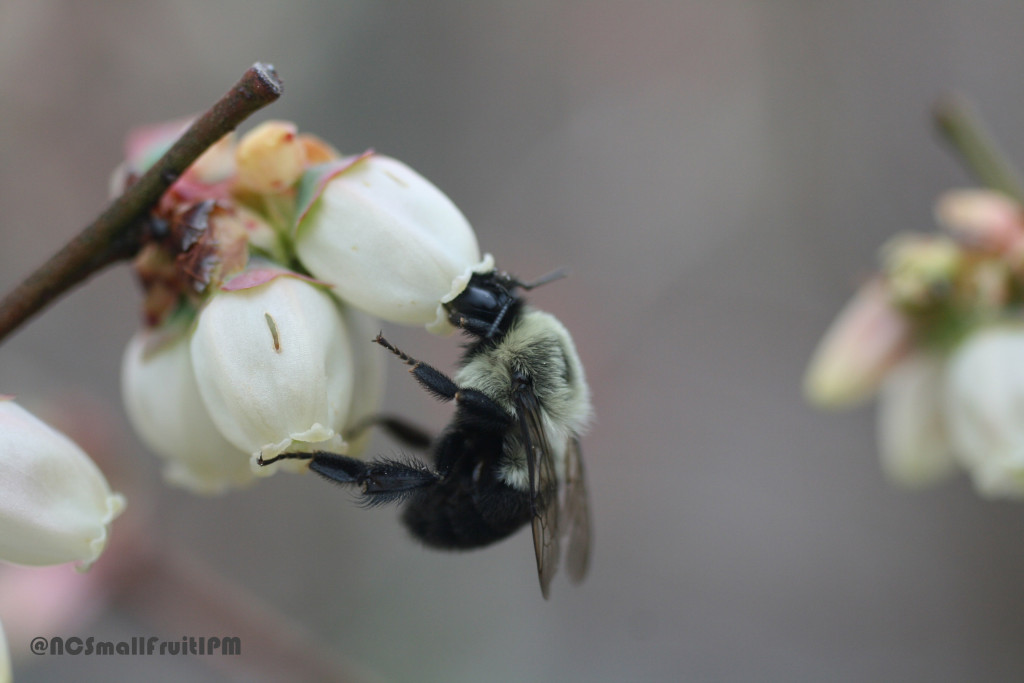 |
| Bumble bee foraging at a blueberry flower. Photo: HJB |
We've posted lots of information about blueberry pollinators at the Entomology Portal, including results from our experiments over the last several years.
Which bees are the best blueberry pollinators?
Does bee diversity change how pollinators behave in blueberries?
Blueberry pollinators - Information on different bee species
Saturday, November 2, 2013
NC State Entomology Portal now live!
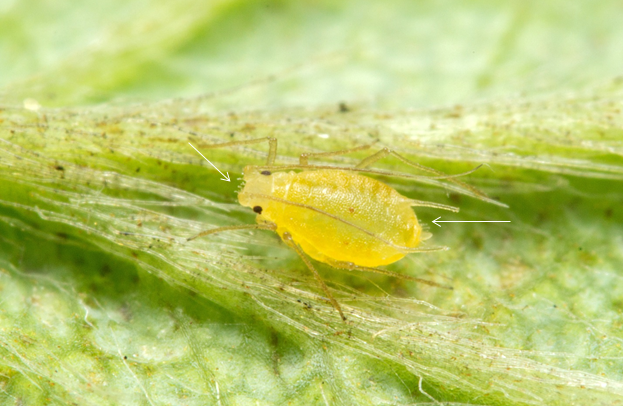 |
| Read about aphids in strawberries at the NC State University Entomology Portal! Photo: Matt Bertone |
Check is out and let me know what you think!
More information
Entomology Portal - NC State University Extension
Friday, September 6, 2013
Late summer grape insect update
The Muscadine Field Day last month afforded me an opportunity to highlight some of the late summer concerns in grapes. Spittlebugs have prompted questions from both bunch grape and muscadine grape growers during the last three weeks. Spittlebugs, commonly referred to as froghoppers, using their piercing-sucking mouth parts to feed on plant phloem. One of the most common species of spittlebugs in North Carolina is the two-lined spittlebug, which as an adult, is a distinctive black with orange/red stripes. Froghopper nymphs cannot fly, and one of the ways they protect themselves from predation is by producing masses of sticky bubbles to cover their bodies. This "spittle" is usually what prompts calls by growers, who are often concerned that their plants have been sickened by a disease.
Spittlebugs rarely cause economic damage in grapes in the southeast. They feed on vegetative tissue, not fruit, and are generally present in low numbers. Spittlebugs can be washed off plants with water (growers may want to use a high pressure sprayer), but unless they are present in large number or found directly on fruit that will be harvested, treatment is usually not necessary.
Prior to the Muscadine Field Day, Bill Cline captured a pair of mating grape root borer moths in the research vineyard at the Horticultural Crops Research Station. Male grape root borers (GRB) are smaller than females, and both males and females are slow fliers, making them easy to spot and capture.
I have been getting reports of GRBs captures in monitoring traps in grower fields throughout August, which is similar to the activity periods that have been observed by our Grape Root Borer Volunteer Monitoring Network (GRB*VMN). Peak GRB activity appears during harvest in many vineyards. Because this also appears to be the case in at the Hort. Crops Research Station, I left them a package of Isomate GRB pheromone dispensers (twist ties) to deploy before next July 1st (before flight activity begins). This dispensers release pheromones that disrupt the ability of male moths to find "calling" females with which to mate. This tactic is called mating disruption, and is a better fit, timing-wise, than pesticide applications for GRB management in North Carolina.
Finally, both Bill Cline and I have received calls in the past several years about fruit drop in muscadine grapes. When these fruit are cut open, the seeds are brown and shriveled, unlike healthy fruit, which have white, firm seeds when unripe.
Growers have asked if this damage may be due to stink bugs, which have been common in vineyards in recent summers. I am not convinced that stink bugs are to blame, however. Stink bug feeding typically results in a tissue response at the feeding site. For example, when stink bugs feed on the midrib of tobacco leaves, the leaf wilts down. Stink bug feeding on fruit, such as apples, pears, or tomatoes, produces a corky mass surrounding the feeding area, and feeding on cotton bolls produces internal "warts". The grapes that have dropped from vines do not have any apparent external damage leading to the discolored seeds, suggesting that the cause was not feeding from the outside.
I suspect, regardless of the cause, that muscadine grapes are likely resilient to early season fruit drop and may compensate by making the fruit that remains larger. Yield on plants with and without fruit drop has not been measured, however.
More information
Do it yourself - Grape root borer monitoring - NC Small Fruit & Specialty Crop IPM
 |
| Spittlebug feeding on muscadine grape vine. Photo: HJB |
Prior to the Muscadine Field Day, Bill Cline captured a pair of mating grape root borer moths in the research vineyard at the Horticultural Crops Research Station. Male grape root borers (GRB) are smaller than females, and both males and females are slow fliers, making them easy to spot and capture.
 |
| Female (front) and male (back) grape root borer moths. This pair was collected while mating by Bill Cline at the Horticultural Crop Research Station, Castle Hayne, NC. Photo: HJB |
I have been getting reports of GRBs captures in monitoring traps in grower fields throughout August, which is similar to the activity periods that have been observed by our Grape Root Borer Volunteer Monitoring Network (GRB*VMN). Peak GRB activity appears during harvest in many vineyards. Because this also appears to be the case in at the Hort. Crops Research Station, I left them a package of Isomate GRB pheromone dispensers (twist ties) to deploy before next July 1st (before flight activity begins). This dispensers release pheromones that disrupt the ability of male moths to find "calling" females with which to mate. This tactic is called mating disruption, and is a better fit, timing-wise, than pesticide applications for GRB management in North Carolina.
 |
| Female grape root borer moth. Photo: HJB |
Finally, both Bill Cline and I have received calls in the past several years about fruit drop in muscadine grapes. When these fruit are cut open, the seeds are brown and shriveled, unlike healthy fruit, which have white, firm seeds when unripe.
 |
| Damaged muscadine grape fruit which had dropped from the vine. Growers suspect stink bug damage, but I am not so sure. Photo: HJB |
Growers have asked if this damage may be due to stink bugs, which have been common in vineyards in recent summers. I am not convinced that stink bugs are to blame, however. Stink bug feeding typically results in a tissue response at the feeding site. For example, when stink bugs feed on the midrib of tobacco leaves, the leaf wilts down. Stink bug feeding on fruit, such as apples, pears, or tomatoes, produces a corky mass surrounding the feeding area, and feeding on cotton bolls produces internal "warts". The grapes that have dropped from vines do not have any apparent external damage leading to the discolored seeds, suggesting that the cause was not feeding from the outside.


I suspect, regardless of the cause, that muscadine grapes are likely resilient to early season fruit drop and may compensate by making the fruit that remains larger. Yield on plants with and without fruit drop has not been measured, however.
More information
Do it yourself - Grape root borer monitoring - NC Small Fruit & Specialty Crop IPM
Monday, August 19, 2013
NC State University Muscadine Field Day - Tomorrow!
The annual Muscadine Field Day is tomorrow, August 19th, at the Horticultural Crops Research Station, Castle Hayne, NC. The meeting starts at 9am and ends at 2pm. See you there!
Wednesday, July 24, 2013
End of harvest concerns in blueberries
As blueberry harvest nears the end in North Carolina, a few important insect related issues require some attention.
Spotted wing drosophila in processing fruit
Rainfall makes SWD management more challenging, as growers have discovered in the last two months. As we move into the end of blueberry harvest, fruit being picked for processing is at higher risk for spotted wing drosophila (SWD) infestation for several reasons: It is often softer than fruit picked for the fresh market, and SWD prefer soft fruit; Processing fruit may be harvested less frequently than fresh market fruit, increasing the time ripe berries are exposed to SWD; Finally, because processing fruit is often machine harvested, all the fruit in the field (good and bad) may be picked.
There are some strategies that growers can employ post harvest to decrease the likelihood that SWD infested fruit will be send off for processing:
1. Hold fruit at cool temperatures. Work in our lab suggests that SWD eggs and larvae cease development at temperatures less than 41F. They will not necessarily die at cool temperatures, but they likely will not cause further damage to the fruit. The longer fruit are held and the cooler the temperature they are held at, the more likely that small SWD larvae will die. Holding fruit at cooler temperatures also give growers the added benefit of determining how significant any infestation is, as large larvae will exit fruit as it cools.
2. Sort out soft fruit. Soft fruit are the most likely to be infested with SWD for two reasons--egg laying SWD are more attracted to soft fruit, and because blueberries become softer as SWD feed. If growers can remove soft fruit before sending fruit off for processing, this will further decrease risk of infestation being present. I suspect our aggressive soft sorting standards for fresh market blueberries are one of the reasons that SWD has been a less significant issue in this crop than some other hosts.
3. Sample collection timing. When receiving fruit, processors can either collect samples before or after fruit are sorted/de-stemmed. Samples collected before fruit has been soft sorted are not necessarily representative of the status of the fruit that will be processed. Samples of fruit after chilling and sorting, prior to processing/freezing are likely more representative.
Post harvest leafhopper treatments
Treatments to manage sharpnosed leafhopper vectors of blueberry stunt disease typically begin post harvest. Blueberry stunt disease is caused by a phytoplasma, and symptoms include "bushy" growth due to short, stunted branches and yellowed leaving during the growing season which may prematurely turn red and fall off in late summer. Most importantly, plants infested with stunt-causing phytoplasma do not produce
Aerial applications of ULV (ultra low volume) malathion been used in the past for leafhoppers, due to effectiveness and ease of application. However, many growers have also used this material for SWD management during the season, and careful attention must be paid to label restrictions on the number of applications that can be made of materials when selecting tools to manage sharpnosed leafhopper. Application limits apply to the entire growing season, not just harvest season, so label limits on the number of applications also apply to leafhopper treatments. Application limits apply the amount of active ingredient, not the trade names of those active ingredients. Sources for updated labels with current use restrictions include CDMS and Agrian.
Alternatives to malathion that are effective against sharpnosed leafhopper include Assail (acetamiprid) and Asana (esfenvalurate). Imidaclorprid and thiamethoxam are also options for sharpnosed leafhopper. The NC Agricultural Chemicals Manual has recommendations for the use of these materials. It's important to note, however, that all these materials pose some risks to pollinators. While blueberries are not in bloom, some of our most efficient blueberry pollinators are ground nesting bees that may remain near fields after bloom. Therefore, any insecticide treatments should be timed to leafhopper flights, ideally determined through trapping, to provide maximum efficacy against target pests and limit unnecessary applications. See here for information on trapping and here for images to aid in sharpnosed leafhopper identification.
More information
How should growers manage spotted wing drosophila in rainy conditions - Strawberry Growers Information Portal
Study offers new insights on invasive fly threatening U.S. fruit crops - NC State University Newsroom
Implementing IPM at the Ideal Track - NC Small Fruit & Specialty Crop IPM
Crop Data Management Systems
Label Look Up - Agrian
Spotted wing drosophila in processing fruit
Rainfall makes SWD management more challenging, as growers have discovered in the last two months. As we move into the end of blueberry harvest, fruit being picked for processing is at higher risk for spotted wing drosophila (SWD) infestation for several reasons: It is often softer than fruit picked for the fresh market, and SWD prefer soft fruit; Processing fruit may be harvested less frequently than fresh market fruit, increasing the time ripe berries are exposed to SWD; Finally, because processing fruit is often machine harvested, all the fruit in the field (good and bad) may be picked.
There are some strategies that growers can employ post harvest to decrease the likelihood that SWD infested fruit will be send off for processing:
1. Hold fruit at cool temperatures. Work in our lab suggests that SWD eggs and larvae cease development at temperatures less than 41F. They will not necessarily die at cool temperatures, but they likely will not cause further damage to the fruit. The longer fruit are held and the cooler the temperature they are held at, the more likely that small SWD larvae will die. Holding fruit at cooler temperatures also give growers the added benefit of determining how significant any infestation is, as large larvae will exit fruit as it cools.
2. Sort out soft fruit. Soft fruit are the most likely to be infested with SWD for two reasons--egg laying SWD are more attracted to soft fruit, and because blueberries become softer as SWD feed. If growers can remove soft fruit before sending fruit off for processing, this will further decrease risk of infestation being present. I suspect our aggressive soft sorting standards for fresh market blueberries are one of the reasons that SWD has been a less significant issue in this crop than some other hosts.
3. Sample collection timing. When receiving fruit, processors can either collect samples before or after fruit are sorted/de-stemmed. Samples collected before fruit has been soft sorted are not necessarily representative of the status of the fruit that will be processed. Samples of fruit after chilling and sorting, prior to processing/freezing are likely more representative.
Post harvest leafhopper treatments
Treatments to manage sharpnosed leafhopper vectors of blueberry stunt disease typically begin post harvest. Blueberry stunt disease is caused by a phytoplasma, and symptoms include "bushy" growth due to short, stunted branches and yellowed leaving during the growing season which may prematurely turn red and fall off in late summer. Most importantly, plants infested with stunt-causing phytoplasma do not produce
Aerial applications of ULV (ultra low volume) malathion been used in the past for leafhoppers, due to effectiveness and ease of application. However, many growers have also used this material for SWD management during the season, and careful attention must be paid to label restrictions on the number of applications that can be made of materials when selecting tools to manage sharpnosed leafhopper. Application limits apply to the entire growing season, not just harvest season, so label limits on the number of applications also apply to leafhopper treatments. Application limits apply the amount of active ingredient, not the trade names of those active ingredients. Sources for updated labels with current use restrictions include CDMS and Agrian.
Alternatives to malathion that are effective against sharpnosed leafhopper include Assail (acetamiprid) and Asana (esfenvalurate). Imidaclorprid and thiamethoxam are also options for sharpnosed leafhopper. The NC Agricultural Chemicals Manual has recommendations for the use of these materials. It's important to note, however, that all these materials pose some risks to pollinators. While blueberries are not in bloom, some of our most efficient blueberry pollinators are ground nesting bees that may remain near fields after bloom. Therefore, any insecticide treatments should be timed to leafhopper flights, ideally determined through trapping, to provide maximum efficacy against target pests and limit unnecessary applications. See here for information on trapping and here for images to aid in sharpnosed leafhopper identification.
More information
How should growers manage spotted wing drosophila in rainy conditions - Strawberry Growers Information Portal
Study offers new insights on invasive fly threatening U.S. fruit crops - NC State University Newsroom
Implementing IPM at the Ideal Track - NC Small Fruit & Specialty Crop IPM
Crop Data Management Systems
Label Look Up - Agrian
Thursday, June 13, 2013
New posts at the NCSU Portals
I found myself in the office this morning--a rare occurrence during field season--and took advantage of the opportunity to post some updates on the Blackberry & Raspberry and Strawberry Information Portals.
Spotted wing drososphila activity increasing at the end of strawberry season - NCSU Strawberry Growers Information Portal
Blackberry psyllid active in North Carolina - NCSU Blackberry & Raspberry Information Portal
Spotted wing drososphila activity increasing at the end of strawberry season - NCSU Strawberry Growers Information Portal
Blackberry psyllid active in North Carolina - NCSU Blackberry & Raspberry Information Portal
Subscribe to:
Posts (Atom)